
If you're relying on email marketing to solve rising customer acquisition costs, don't be surprised when the results leave you severely disappointed.
Rising CAC is a structural problem before it becomes a channel problem. Sending more emails, more texts, more WhatsApp messages and more direct mail to compensate for structural issues in the business is the most common mistake I see brands make, and it consistently fails.
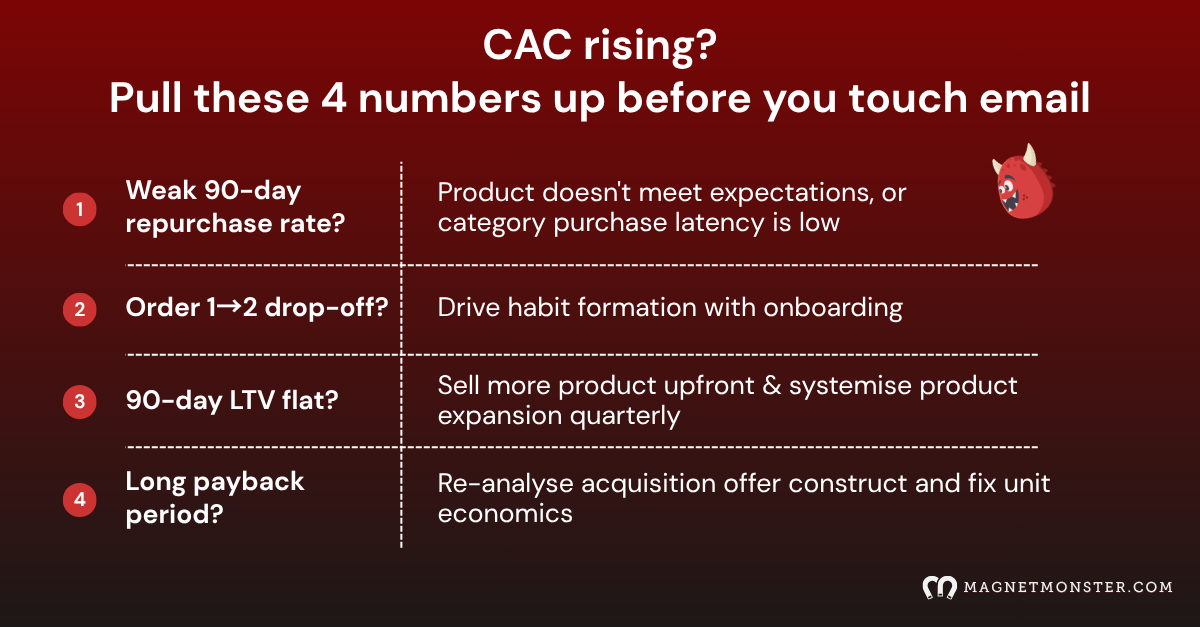
Before you hire a retention agency or double your campaign cadence, diagnose four metrics:
- Your 90-day repeat purchase rate
- Your order one to order two drop-off
- Your 90-day LTV, and
- Your CAC payback period
Each one points to a different structural fix. Email only compounds results once those foundations are in place.
Here's how to analyse each of the four, and what to actually do about them.
Why doesn't more email fix rising customer acquisition costs?
Because the causes of expensive acquisition rarely live inside your ESP.
Pretty much every brand in the world is suffering from increasing customer acquisition costs right now. The natural inclination is to double down on retention channels and squeeze more revenue from the customers you already have.
The logic sounds right. The execution disappoints, because most of the time the retention channels are being asked to compensate for problems they cannot touch: a product the category doesn't repurchase, an onboarding experience that loses subscribers before order two, an acquisition offer that attracts the wrong buyers.
Retention is downstream of these things. Fix the business first, then let the supporting channels amplify what's working.
The four metrics below tell you where the actual problem sits.
What is a good repeat purchase rate for eCommerce?
Start with your 90-day repeat purchase rate. You can look at 30, 60 or 90 days, but 90 is a good benchmark for most brands.
Before you judge the number, understand the category you're selling in. Is your product actually built for retention?
If you sell furniture or mattresses, how often does a customer need to buy again? Not frequently. No strategy, especially over email, meaningfully influences that number. The honest move for these brands is cross-product expansion: building an assortment of logical upsells and cross-sells that are native to your hero SKU. If you sell mattresses, that's bedding and pillows.
You can map this by looking at what products people actually come back and buy after their first purchase. For most brands, around 80% of first-time sales are the hero SKU, so the 80/20 rule applies to your analysis too.
Now switch to CPG, where the product is designed to be consumed every month or two. Here, customers mostly come back to buy the same thing they came in on. So the analysis is simple: when do they repurchase the hero SKU, and do they repurchase it at all?
If that figure is sub-20% over a three-month timeframe, you have a major problem with the product. Either you're mis-selling it, it doesn't deliver on expectations, or there's no novelty attached to it.
Check the qualitative signals, analyse your reviews and customer sentiment. Does the product actually give customers results? If it does, the repurchase rate grows organically, irrespective of whether you're emailing anyone.
Read: How to Implement Qualitative Research in Klaviyo
Why do subscribers churn between order one and order two?
This one is specific to subscription brands, and it's the drop-off that matters most.
There is a myriad of reasons someone churns at order two, and most of them have nothing to do with your email cadence:
- Customers gaming an aggressive introductory offer, taking the 50% discount and cancelling before the second billing
- Billing reminders framed the wrong way
- Customers not using the product, or sitting on too much of it by the time the next charge comes around
- Poor onboarding that never sets expectations properly
If 40 to 50% of your subscribers churn before order two, you are not onboarding and setting expectations correctly. A customer on a monthly product who never reaches order two is telling you one of four things:
- They're not getting results
- They have too much product
- They don't know how to use it, or
- The perceived value was manipulated by the introductory offer.
Every one of those is a structural issue that email alone can't solve. Fix the onboarding window first. I've covered exactly how in the subscription revenue playbook, including when the churn risk stops and the upsell opportunity starts.
Read: Why Your eCommerce Subscription Revenue Has Plateaued (And What To Do About It)
How do you increase 90-day LTV without sending more emails?
Many people conflate 90-day LTV with repeat purchase rate. There's overlap, but they are not the same lever.
You can increase LTV without moving the repurchase rate at all, and the clearest route is selling more upfront.
For the majority of brands, subscription or not, giving customers more product on the first order is the right move. It commits them to the product, and it collects more cash upfront. More cash upfront means you can afford to spend more on acquisition. That alone changes what a "high" CAC means for your business.
The second lever is novelty, and it's chronically underrated, especially in CPG.
If you sell supplements or nutritional products, how often are you releasing complementary flavours or synergistic products that pair with your hero SKU? Novelty drives retention in almost every category. I watch how my sisters consume promotional content from fashion brands: new releases, seasonal drops, new additions to the assortment. That's what brings them back.
We work with a fragrance brand where this is a critical part of the business model. New scents mapped throughout the year: limited edition drops, collaborations, etc. It's all planned into the calendar in advance.
Map out your own year the same way. Give people something fresh to come back for and LTV rises across any timeframe you measure.
Read: How to Scale LTV From Your Existing Subscribers: A 4-Play Upsell Playbook for DTC Brands
How do you improve your CAC payback period?
The payback period is when you actually break even on your acquisition cost, and everything above feeds into it.
But there's one input the other three metrics don't cover: the acquisition offer itself.
Be aware that pulling the levers on this list can push your CAC up while making the business more sustainable. Acquiring subscribers through Meta costs more than acquiring one-time purchasers. The upside is a customer base with far better long-term economics.
So look hard at the front end. The positioning, the messaging, the hook that brought someone in, and the entry-level product they landed on. Then measure the payback period for that specific offer and audience.
That analysis tells you who your best customers actually are, when they come back, and how much they spend over time. It should reshape your whole funnel: the ads construct, the messaging, the customer journey, all of it.
Read: Ecommerce Unit Economics: Why Your LTV:CAC Ratio Is Wrong
Where does email actually fit?
Email and retention channels help improve every metric on this list. But they compound what already works. They don't repair what's structurally broken.
If your product doesn't deliver results, email can't manufacture repurchases. If your onboarding loses half your subscribers before order two, a bigger campaign calendar just reaches more people on their way out. If your acquisition offer attracts discount hunters, retention channels inherit that problem with every send.
Fix the business first. Then build the supporting channels around it and let them compound.
Frequently asked questions
What is a good repeat purchase rate for an eCommerce brand?
It depends on the category more than the marketing. For CPG products designed for monthly consumption, a repurchase rate below 20% over a three-month window signals a product problem rather than a channel problem: the product isn't delivering on the expectations set at acquisition. For long-cycle categories like furniture, a low repeat rate on the hero SKU is natural, and the better question is whether your assortment gives customers anything logical to buy next.
How do you reduce customer acquisition cost in eCommerce?
Mostly, you don't reduce it. You make it affordable. Rising CAC is a market-wide condition, so the durable response is improving what each acquired customer is worth: sell more product upfront to collect cash earlier, fix the onboarding window that determines whether subscribers reach order two, build a novelty calendar that gives customers reasons to return, and refine the acquisition offer so it attracts buyers rather than discount hunters. Brands that only chase cheaper clicks lose to brands that can outspend them on the same auction.
What is the CAC payback period and why does it matter?
The CAC payback period is the time it takes to break even on the cost of acquiring a customer. It matters because it dictates how aggressively you can spend. A brand that recovers its acquisition cost on the first order can scale spend almost without constraint. A brand that needs three orders to break even is betting on retention performance it may not have. Measure payback by offer and entry product, not just as a blended average, because different hooks attract customers with very different economics.
Does email marketing reduce customer acquisition costs?
Indirectly, and only when the foundations are right. Email improves repeat purchase rates, supports onboarding, and drives the reviews and referrals that lower blended acquisition costs over time. What it cannot do is compensate for a product the category doesn't repurchase or an offer that attracts the wrong customers. Treat email as a compounding layer on top of sound unit economics rather than a rescue mechanism for broken ones.
Why is my subscription drop-off so high between order one and order two?
Usually one of four reasons: customers gamed an aggressive introductory offer, they aren't using the product consistently enough to see results, they've accumulated too much stock by the time the second billing arrives, or the onboarding never set expectations properly. All four are fixable, and none of them are fixed by sending more campaigns. The first 30 to 45 days of product education, habit formation and correctly framed billing reminders determine whether order two happens.
Conclusion
Rising customer acquisition costs are not an email problem, and treating them like one is how brands burn twelve months and an agency retainer discovering what the data already told them.
While DTC brands don’t consider the four metrics together, they do the diagnosis for you:
- A weak 90-day repeat purchase rate points at product-category fit or the product itself.
- A steep order one to two drop-off points at onboarding and offer construction.
- A flat 90-day LTV points at upfront order value and novelty.
- A long payback period points at the acquisition offer and who it's attracting.
Work through them in order and fix what the numbers surface. Then point your email, SMS and direct mail at a business that's structurally sound, and watch the same channels that disappointed you start giving you results.
Read: Retention Marketing Strategy: A Practical Playbook by Business Model
Want more of this in your inbox? Subscribe to our newsletter and YouTube channel for weekly DTC retention strategies, extracted straight from the brands we work with. No fluff, just actionable plays.

.svg)





1.png)
.png)