Most of what you've been told about segmentation is either a lie or a wasted effort.
"Personalization!" and "Hyper-segmentation!" are the buzzwords thrown out by marketers as key levers to growth.
But neither of these platitudes takes into account human behaviour's unpredictability and transient nature.
Here’s why we need to re-think conventional knowledge regarding segmentation strategy in Klaviyo or any ESP you’re using to target customers.

Predicting Customer Behaviour is Hard
Let's say you own a supplement store.
You create 3 types of campaigns for each bucket of customers in your campaign strategy.
That's 3 sets of copy, creatives and distinct strategies based on this initial buying behaviour.
And then you realise something...
John, who initially wanted to build muscle last winter, is now trying to get shredded before his summer holiday.
But you've been excluding John from all your marketing campaigns for fat burners because you assumed he only wanted to build muscle based on his first purchase.
The problem? Customer behaviour changes over time.
People's goals and interests are not static - they have overlapping reasons they buy from you.
It makes sense to treat customers differently with automation in their first interactions with you to maximise conversions and guide them through their journey.
But it's illogical to think they won't alter their beliefs further down the road.
So if you're a store with a well-defined niche and proposition, go BROAD with the majority of your targeting in campaigns.
You want to maximise impressions/reach, TOTAL conversions, and minimise resource allocation & maximise profitability.
"Right message at the right time" is much easier to predict when somebody is interacting with you for the first time.
You can give somebody a mohawk the first time they sit in a barber's chair based on what they tell you.
But you wouldn't run the clippers over their head in the same way 1 year from now the next time they visit without first asking them what they want.
DON'T MISS: Know what's wrong with your Klaviyo account or how to enhance its performance? Get a FREE Klaviyo Health Audit worth $3,000
“Are you proposing we treat everybody the same with segmentation?”
No - I’m saying we naively overestimate our ability to predict customer behaviour, leading to inefficiencies within any organisation that bleeds cash.
I also think marketers gloss over the concept of resource allocation and labour costs because they want to feel clever and sophisticated.
A basic segmentation strategy feels underwhelming because it doesn’t require a lot of thinking.
But your goal isn’t to feel as though you’ve spent a lot of time feeling clever, and it’s to maximise the results of the brand in terms of the most profitable strategy possible.
And creating 3 lots of creatives and strategies (as in the example above) without clearly defined cohorts will lead to 3 X the production costs.
This is fine if there is a clear route to ROI to warrant the additional investment, but poor resource allocation if not.
“But segmentation improves click rates!”
As email marketers, we're always told to monitor click rates to gauge the effectiveness of our campaigns.
I disagree.
While click rates do provide good insights into how effective our content and offer resonates with our audience, it's wrong to track this metric in a bubble.
Why?
Because segmentation can dramatically improve click rates by narrowing down your audience to increase the relevancy of the offer.
...but you'll also narrow down your audience.
And if you're a marketer, your goal is to maximise your campaign's total reach and conversions for the highest ROI.
Let's consider 2 scenarios.
Option A)
Let's say you have 100k subscribers.
With hyper-segmentation, you start sending to a cohort of 10k per month, and you're pretty happy with your 5% click rate, which generates 500 visitors to your website with each send.
If you send 10 campaigns per month, that's 5,000 engaged subscribers visiting your website.
Pretty impressive on the surface.
Option B)
This marketer goes broad, and after some deliverability and analysis to ensure they're not battering the database, they decide to target 50k customers per send.
Click rate drops to 2%, which generates 1,000 visitors to your website per send.
If you send 10 campaigns per month, that's 10,000 visits per month - a 100% uplift on your previous segmentation strategy.
Not to mention the brand equity that comes with the increased impressions from going broad.
You've reduced your click rate but increased your campaign's traffic, conversions and impressions.
Which strategy would you prefer for your business?
Now, there are definitely other considerations here I skirted over, such as unsubscribes + costs of your ESP for the additional sends (minimal) that need to be considered, but the logic remains the same.
Your goal is to maximise the number of impressions and conversions from each campaign.
Falling into the trap of isolating click rate in a bubble will feel good as a channel marketer but be bad for the business you serve as a whole.
A good starting point for segmentation for most campaigns
I recommend using basic engagement tiers to target your audience on a campaign level based on the recency of activity, using 30, 60, 90, and 180-day engaged segments, blending together site activity and email responsiveness, like this:

Depending on how you’re managing consent, you’ll also need to have a condition in there to include “In Newsletter List” as well in some scenarios.
Are there exceptions to the rule?
Yes - many.
The above example I provided is a generic starting point. I’m not saying it’s the be-all and end-all of segmentation - it isn’t. Lots of additional factors will influence your strategy, such as the eCommerce businesses:
- Diversity of product catalogue (i.e. large retailer VS niche offering)
- Seasonality of product catalogue and buying behaviour
- Purchase latency between SKUs or category
And many, many more I’m probably skirting over.
However, suppose you are a niche eCommerce brand with a very clear offering (i.e. yoga store, dental care, bodybuilding). In that case, you should keep the majority of your campaign strategy focused on broad targeting to maximise efficiency and ROI.
Even if you have a large, diverse store offering a multitude of products serving differing customers, never forget that your goal is to maximise efficiency and reach as many people as often with your campaigns to generate the best possible economic outcome.
Two quick caveats before this list: RFM groups need Klaviyo's Advanced KDP/Marketing Analytics add-on, not the standard plan, and predictive analytics (CLV, churn risk, expected next order) only shows up once you've got real order history behind you - at least 500 customers with a placed order, 180+ days of history, and some repeat buyers.
If you're a newer or smaller store, this section's your future roadmap more than today's to-do list - which is exactly why 'go broad for now' above is still the right call for you.
If you are going to segment, segment on things that actually predict behaviour
Everything above is about not over-segmenting your campaign targeting. But there's a difference between hyper-segmenting your campaign audience and using the right segments for the right job - flows, VIP treatment, win-back, BFCM. Here's where I'd actually spend the effort.
RFM groups
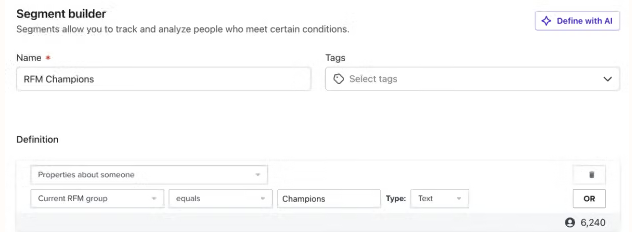
Klaviyo already buckets every profile into one of six groups for you - Champions, Loyal, Recent, Needs Attention, At Risk, Inactive - based on recency, frequency and monetary value. You don't have to build this from scratch: the condition is "Properties about someone > Current RFM group > equals > [group]." Protect margin on Champions and Loyal with smaller or no discounts (referral or review incentives work better here), and save your bigger discounts for Needs Attention and At Risk, where they'll actually move someone rather than subsidise a purchase that was happening anyway.
Predicted CLV and Churn Risk
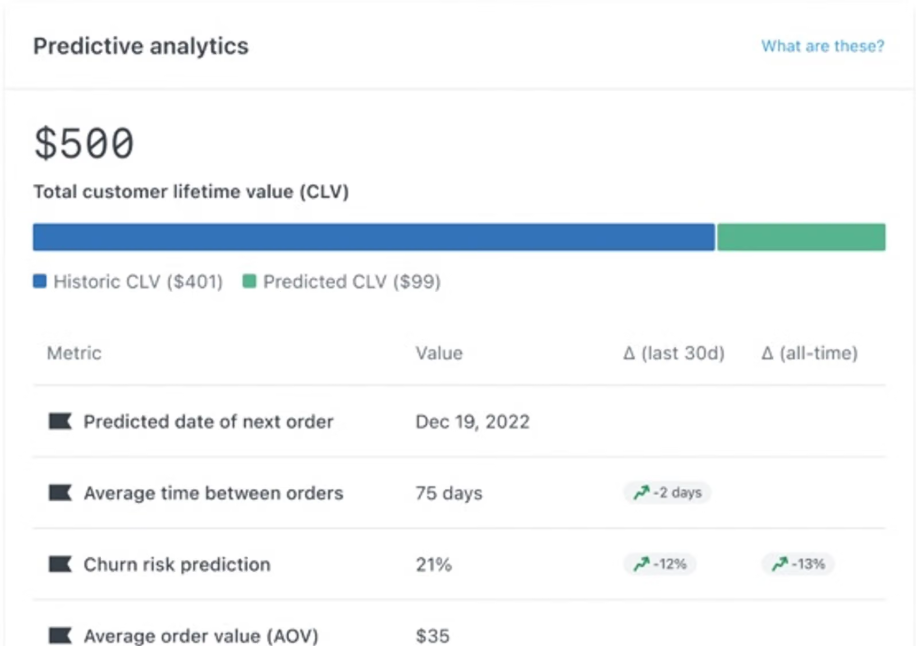
These are forward-looking, not just historical. Predicted CLV estimates what someone will spend in the next 12 months, which is a better VIP filter than "has spent a lot before" alone. Churn Risk flags who's about to go quiet before they actually do, which is the difference between a win-back flow that works and one that's a eulogy.
Expected Date of Next Order
If you sell anything with a repeat purchase cycle, this is worth its own flow, not just a segment - see our guide to setting up the EDNO flow if you haven't built it yet.
BFCM
The same fields do the work here. Give early access to Champions and Loyal (your RFM groups again) before you open a sale to everyone, and build a specific "high Predicted CLV, not yet purchased this cycle" segment for your best prospecting spend during the period, rather than blasting one static VIP list built six months ago.
Klaviyo's AI segment builder
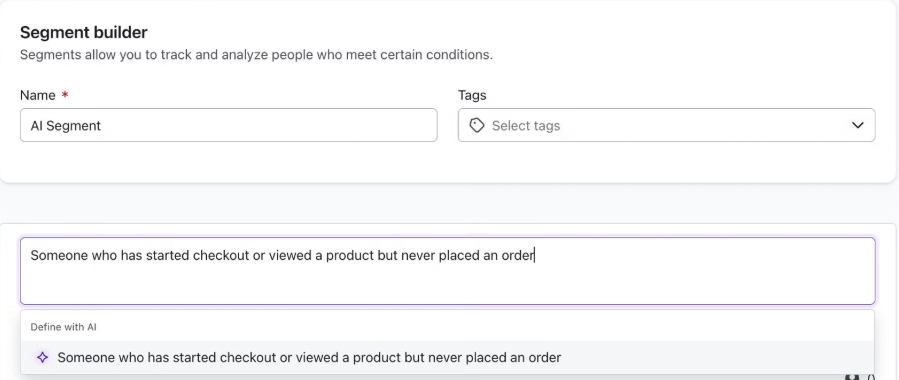
if you haven't tried it, is a genuinely useful shortcut for one-off segments: type something like "engaged profiles last 30 days" or "viewed a product but hasn't purchased in 60 days" straight into the condition selector and it'll draft the logic for you. Worth checking the definition it gives you rather than trusting it blind, but it's faster than building most one-off segments by hand.
None of this contradicts what I said above. Going broad on campaign targeting and using real predictive fields for flows, VIP treatment and win-back aren't in tension - the mistake is doing the second thing to your campaign audience too, which is what most hyper-segmentation advice actually tells you to do.
Happy segmenting!
FAQ
What are the best Klaviyo segments to build?
Rather than a long list of campaign micro-segments, focus effort on RFM groups (Klaviyo builds these automatically), Predicted CLV for VIP targeting, Churn Risk for win-back timing, and Expected Date of Next Order for replenishment flows - these predict behaviour, unlike most demographic or one-off engagement segments.
Does Klaviyo have RFM segmentation?
Yes, natively - Klaviyo automatically groups every profile into one of six RFM categories (Champions, Loyal, Recent, Needs Attention, At Risk, Inactive) based on recency, frequency and monetary value. One caveat: this lives under Klaviyo's Advanced KDP/Marketing Analytics, which isn't included in the standard plan and requires its own subscription.
What is Klaviyo's AI segmentation feature?
Klaviyo lets you type a plain-language description (e.g. "engaged profiles last 30 days") into the segment condition selector, and it converts that into the underlying segment logic automatically. It's a real, current feature on paid Klaviyo accounts - useful for one-off segments, though you should still check the definition it produces.
What segments should I use for BFCM in Klaviyo?
Give early access to your RFM "Champions" and "Loyal" groups before opening a sale to everyone, and build a "high Predicted CLV, hasn't purchased this cycle" segment for your best prospecting spend during the period - both use fields Klaviyo already gives you, rather than a static VIP list built months earlier.
Is hyper-segmentation actually worth it for ecommerce brands?
Usually not for campaign targeting - narrowing your campaign audience shrinks total reach and conversions even when it improves click rate, which is a bad trade for most brands below 8 figures in revenue. It's a different story for flows and lifecycle moments (win-back, VIP, replenishment), where segmenting on predictive fields like Churn Risk or Predicted CLV is worth the effort.
If you found this article useful, please follow me on Twitter and LinkedIn. Check out our newsletter too where I break down eCommerce email marketing strategies we use with our clients daily.
Related Reads Curated for You
If you enjoyed this Klaviyo guide, we're pretty sure you'd enjoy the other parts in this series:
- How Does Klaviyo Work? A Helpful Guide
- How to create a Date-Based Property Flow in Klaviyo
- How to create a Net Promoter Score Flow in Klaviyo
- How to create an epic Post-Purchase Flow in Klaviyo
- How to Implement Qualitative Research in Klaviyo
- How to use Klaviyo's Predictive Analytics
- How to Use Klaviyo: Learn the 5 Big Mistakes to Avoid

.svg)





1.png)
.png)