
Most subscription brands are leaving millions in lifetime value (LTV) untouched because they followed advice that was only half right.
The advice? Never email your active subscribers. That rule only applies during the first three orders. After that, staying silent is a growth ceiling you built yourself.
This post covers when to switch from churn prevention to LTV maximisation, how to segment for it, and what to actually send when you do - with real client examples across supplement, skincare, and lifestyle subscription brands.
The myth costing subscription brands millions
If you run a subscription business, you've heard it: “Never email your active subscribers. You'll remind them the box is coming, they'll cancel, and you'll watch your MRR bleed out.”
I've worked with over 50 subscription brands from 7 figures to high 9 figures and this is one of the most expensive myths in DTC.
But I know it comes from a real place, and it deserves a fair hearing.
Email an active subscriber at the wrong point in their journey and yes, you will churn them. While I agree that part is true, the problem is the advice stops there. It doesn't tell you when the risk stops.
So brands stay in defensive mode forever and cap their own growth.
At some stage, an active subscriber stops being a churn risk and starts being a lifetime value opportunity. Knowing when that switch happens is the biggest opportunity most subscription brands have that doesn't involve acquiring a single new customer.
That's what this is about: When to go in, when to stay out, and what to send when you do.
When should you start emailing active subscribers?
Start with the retention curve.
Pull up your subscriber retention curve. If you manage a subscription business, you already know this view.
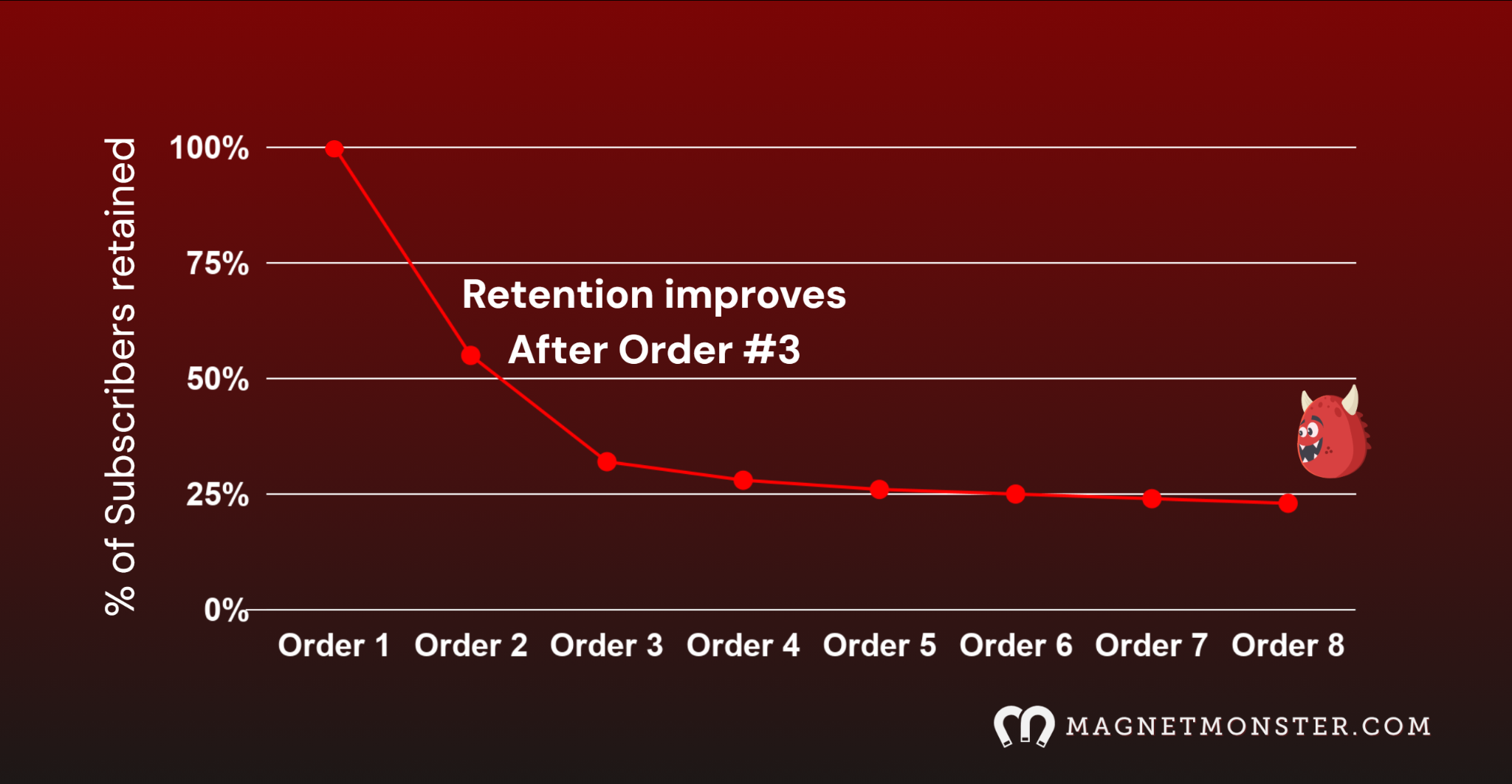
The shape is almost always the same across DTC. Churn is brutal from month 0 to month 3. That's where most of your subscribers leave.
That's also where the myth was born. People looked at that cliff, saw emails going out during it, and drew a straight line between the two.
Then watch what happens after month three. The curve flattens.
Flattening is the signal. At that point you can assume someone is reasonably happy with the subscription. They're not shocked when the package arrives. The habit is built.
That's your switch - Your objective changes from churn prevention to maximising recurring AOV, or average revenue per user.
The graph tells you which mode you're in, and most brands never look at it before deciding their campaign strategy.
Also read: How to Scale LTV From Your Existing Subscribers: A 4-Play Upsell Playbook for DTC Brands
Should you measure subscriber retention by month or by order number?
This is the caveat worth more than most of the advice you'll read on this topic.
Toggle your graph from months to order number. Month 0, 1, 2, 3 becomes order 1, 2, 3.
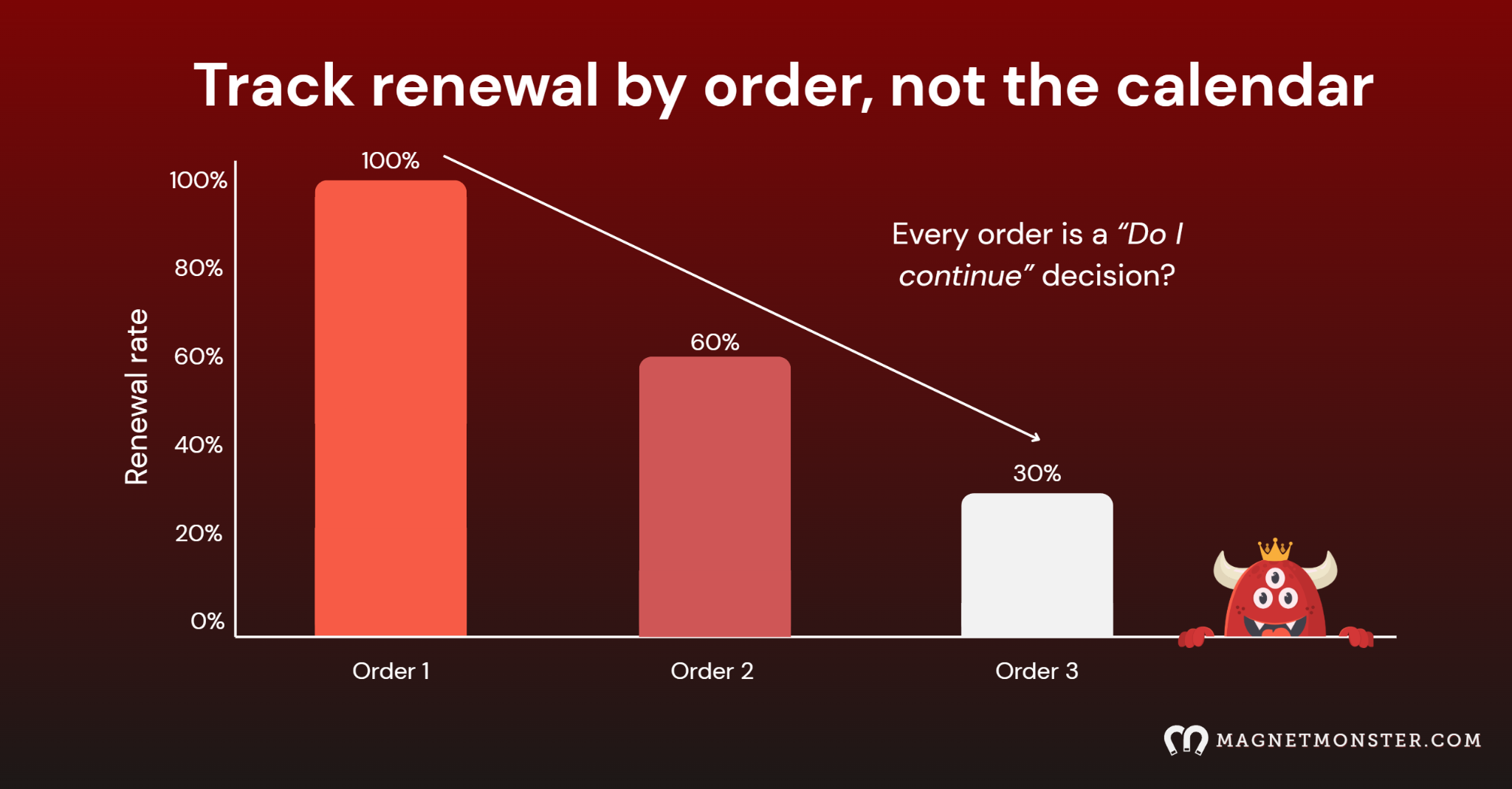
People skip. People pause. A subscriber who skipped twice is at month 3 and order 1, but the month view will tell you they're settled when they've barely used the product.
They haven't been billed again. The habit isn't built. Meaning the month view is lying to you.
Plenty of brands sell 60 or 90 day supplies up front, so months mean almost nothing there. Not everyone sells on 30-day increments.
I nearly always prefer the order view for exactly this reason. Look at both but trust the order number.
The takeaway for you either way: at month three or order three, churn flattens and the curve stabilises. That's when you start looking at upsells and lifetime value from your best customers.
They're happy. They're in the ritual. So why wouldn't you go in?
Also read: How to Reduce Churn and Boost Engagement in D2C Subscriptions Ft Matthew Holman
How do you segment a subscription brand's email list?
You can build endless segments for a subscription brand, same as any brand. I prefer to keep it simple. About 90% of the accounts I work with run this basic framework.
Three buckets.
Bucket one: prospects, one-time customers, churned and lapsed subscribers
Everyone without an active subscription goes in here, and that matters more than it sounds. Not everyone subscribes. A big chunk of your database bought once and never came back, and another chunk subscribed and left.
These people cannot churn a subscription they don't have. There is no downside risk.
So send them everything. Every offer, every piece of content, every promotion. Any lead that lands in Klaviyo or whatever ESP you're on should be getting hit with as many campaigns as it takes.
One job in this bucket: get them onto an active subscription as the default core offering.
Bucket two: active subscribers at 3+ orders
Active subscribers below the 3+ orders threshold get the onboarding flow that drives habit formation and teaches them how to use the product. They get the rest of the lifecycle infrastructure.
They do NOT get the daily or weekly campaign, whatever your cadence is.
This isn't because emails are evil. It's because churn risk is highest here and these customers aren't settled. They might not be using the product every day yet.
And to call a spade a spade, every marketing communication you send is a reminder that cancelling exists. Roughly 70% of portal visits are already intent to cancel.
Don't show someone the exit sign during the exact window they're most likely to walk through it. Reduce the noise until the curve stabilises.
Bucket three; active subscribers who've crossed 3+ orders
You don't need to email 3+ order subscribers with every campaign you send bucket one. That's the trap people fall into when they finally get permission to email subscribers, and it's how the myth gets reinforced.
For subscribers in this bucket, one to two curated offers a month is enough. The goal is adding another product into the subscription. Not filling an inbox.
What does this segmentation look like in practice?
Your biggest opportunity to expand LTV lies in bucket three that we saw above. Here's what to send them:
1. The logical cross-sell
Take a kids multivitamin brand.
- "How to make sure your child isn't vitamin deficient." General education, adds value, nurtures. That goes to bucket one.
- "15 essential vitamins inside our multivitamin." Product-led. Bucket one.
- "The importance of taking a daily multivitamin." Bucket one again.
If it's product related and it's pushing toward a subscription, it goes to the people who don't have one.
2. The free SKU mechanic
The single highest-performing play we've run at Magnet Monster: identify a low cost SKU where the margin is very high, then give it away free to the customer inside the next renewal.
It's completely de-risked for them. You get a lot of product in a lot of hands. A decent share of people who like it go on to renew it.
It works especially well with supplement brands, which if we're honest is probably 80% of subscription brands these days.
3. Reframe the billing reminder from a churn risk to an LTV opportunity
The billing reminder is your biggest asset, not your biggest risk.
Everyone treats the order upcoming email as a liability. Send the billing reminder, trigger the cancellation. So it goes out as a bare legal minimum, or people panic about sending it at all.
Using AMP technology from Zaymo, one of our software partners, you can put a widget inside that email that adds complementary products to the existing subscription. The customer taps. It's in the box. No checkout, no portal visit.
But the widget isn't really the point. Instead it is the reframe.
That email stops being "we're about to charge you" and becomes "here's what's coming and here's how to get more out of it." It builds on the existing habit and ritual, and it holds the customer accountable to the results they signed up for.
You're swapping a fear-based message that produces a negative action for something that drives excitement. That's a massive point of leverage sitting in an email nearly every subscription brand already sends.
Don't miss: Why You're Wrong About Emailing Your Subscribers: The Billing Reminder Playbook (With Brice Douglas, Zaymo)
4. The bulk upgrade play
Same email, different lever.
If you sell subscriptions in bulk, someone hits that third order threshold and you want to juice lifetime value and improve cash flow, offer the upgrade from a one month supply to three. This works inside the email itself and it is doable with the same technology.
Real examples from our client accounts
Hiya Health. Most customers come in on the hero product, the multivitamin. But there's a complementary assortment sitting there. So the cross-sell writes itself: we hope you're enjoying the multivitamin, why don't you try the probiotic too, now is the right time to add it to your kid's stack.
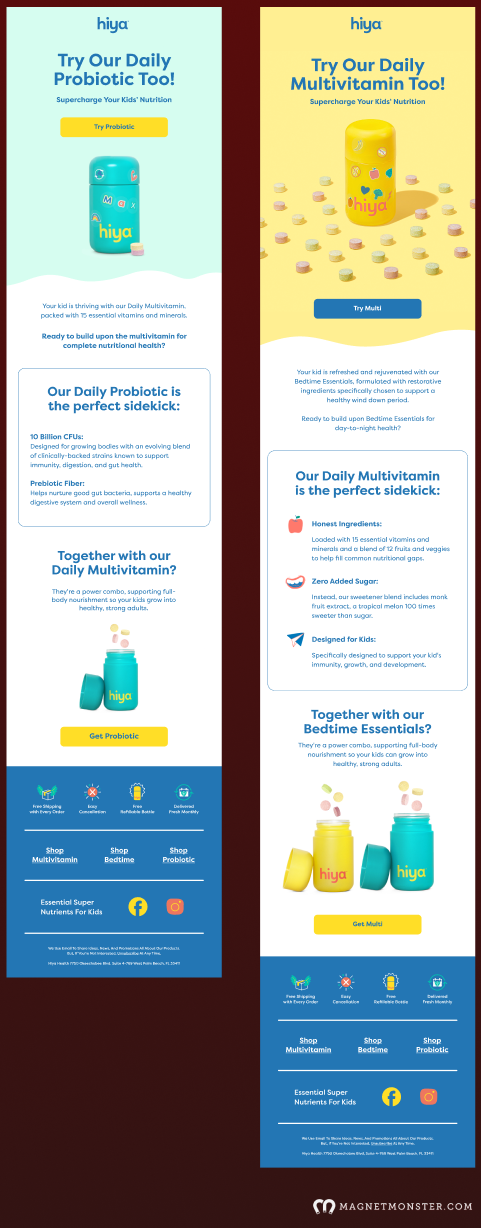
Basic cross-sell education email. Nothing clever.
Use the quick action links in Recharge, Skio, Loop, whatever subscription software you're on, and redirect people straight to a checkout where the product drops into the cart or subscription. Don't make them go hunting for it.
Livingood Daily. We've run challenges. Build-your-own-bundle mechanics. There's a lot of education around supplements that bodes well with this type of idea. You're using this, you're getting results, you're building the habit, now is the right time to add this to the mix.
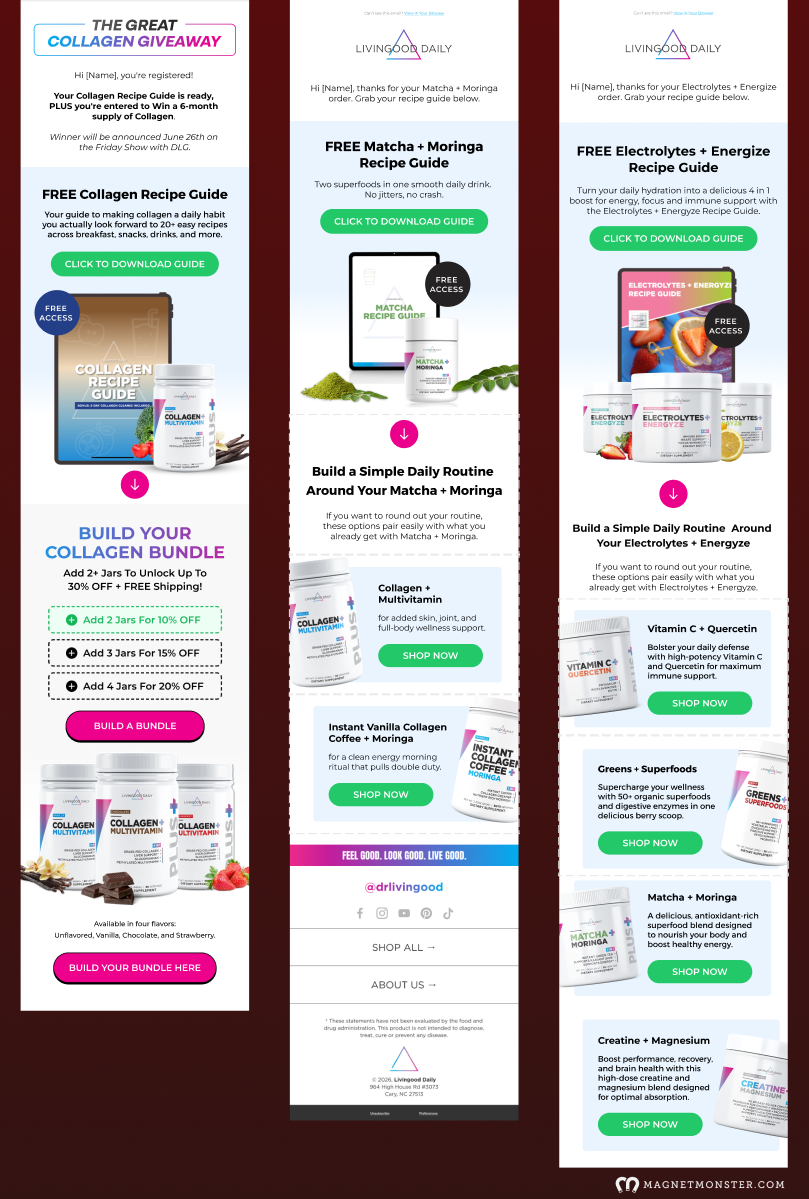
If you have a large catalogue, the ideas are endless.
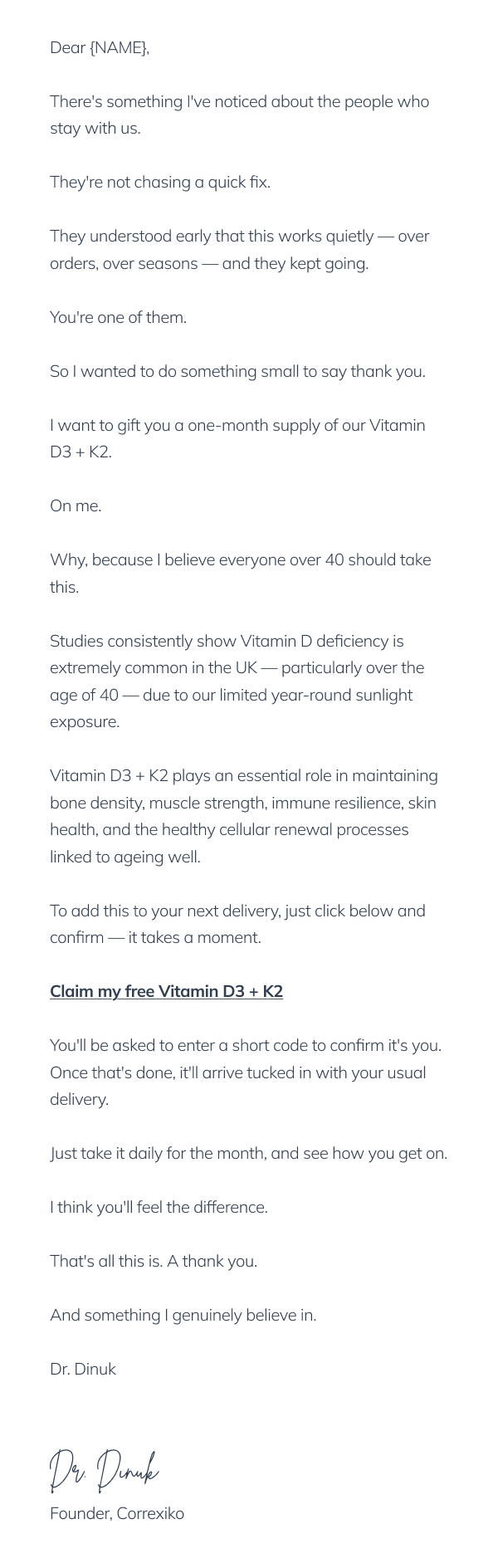
Correxiko. We email the collagen subscribers about adding Vitamin D3 + K2 to the stack. What makes it work is that it comes from Dr. Dinuk, the founder.
Plain text emails perform especially well here. Get them into the mix.
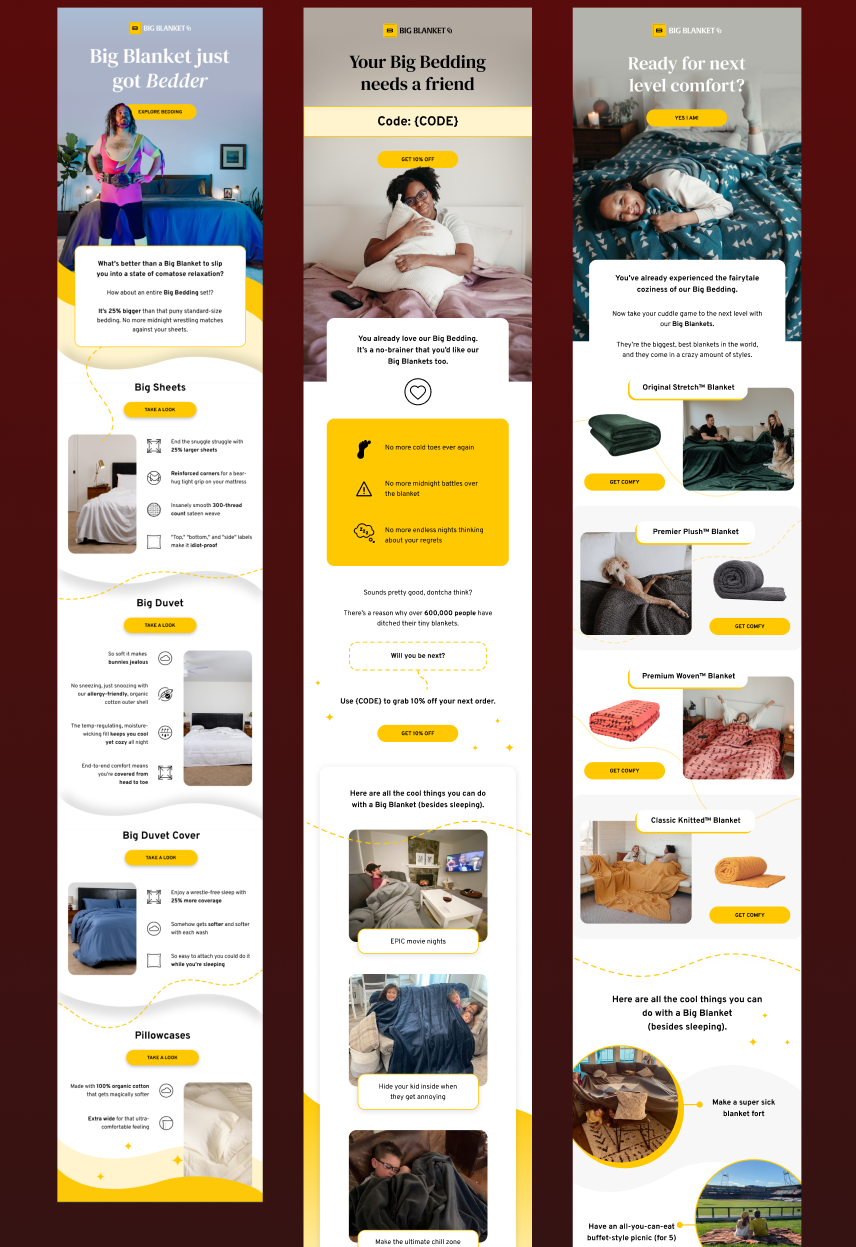
Big Blanket. Not a subscription brand, but the same concept and the designs are great. Someone buys the big blanket, you want them on the bedding product. Identify the commonality, complement what they already own.
How do you avoid over-complicating the cross-sell strategy?
Here's the trap on the other side.
If you have a very big product assortment, this gets convoluted fast. Don't build dozens of permutations.
Find the hero SKUs where 80% of people subscribe and map the logical cross-sells off those.
Otherwise you end up with a Frankenstein monster of post-purchase flows in the account. I've seen it many times, built with the best intentions every time, and nobody can maintain it.
The rest of it is straightforward. Some brands run educational emails on this pattern. Bliss run "you're using this product, experiment with adding these into your skincare regime."
Logical cross-sells and product education that builds on existing habits and rituals. That's the whole game. Don't over-complicate campaigns.
When should you switch on upsell and cross-sell emails?
At Magnet Monster, we actually set these up for lots of clients right from the very first order.
But if you want to be more bullish about adding products into the mix, order three is the logical point. The curve has flattened, churn risk has really dropped, and the ask lands differently.
Run holdout tests to confirm it's incremental. You should be doing that anyway rather than taking my word for it.
FAQs
Should you ever email active subscribers of a subscription brand?
Yes, but only once they have passed the third order threshold and the retention curve has stabilised. Before that point, email communications carry a genuine churn risk because the habit is not yet formed and every promotional message is a potential trigger. Around 70% of subscription portal visits happen with intent to cancel during this early window. After order three, the risk profile changes completely and targeted cross-sell and upsell campaigns become one of the highest-return levers available.
How do you know when it is safe to start emailing active subscribers?
Look at your retention curve by order number rather than by calendar month. The inflection point where churn stabilises is typically around the third order for most subscription brands, though this varies by category and consumption cycle. Once the curve flattens, the objective should shift from churn prevention to LTV maximisation. Always toggle the view to order number rather than months because skips and pauses distort the month view significantly.
What is the best segmentation strategy for a subscription brand's email list?
Two core buckets cover 90% of what you need. The first is prospects, one-time purchasers, and lapsed subscribers who can be emailed freely with any offer since they have no active subscription to cancel. The second is active subscribers at or beyond the third order threshold who are the target for curated cross-sell and upsell campaigns at a frequency of one to two per month. Active subscribers below the third order threshold sit outside both buckets for campaigns and receive only the onboarding flow.
How often should you email active subscribers who have passed the third order threshold?
One to two targeted offers per month is sufficient. These customers do not need to receive every campaign in your standard cadence. The goal is adding complementary products to their existing subscription rather than filling their inbox. Frequency matters less than relevance at this stage.
What is the most effective cross-sell tactic for subscription brands?
The highest-performing mechanic across the supplement brands we work with is identifying a low-cost, high-margin SKU and offering it free inside the next renewal. The customer receives the product at no risk. If they like it, they renew it. Product in hands drives repurchase far more reliably than any email describing the product. Plain text emails from the founder also consistently outperform designed templates for cross-sell campaigns to active subscribers.
How can the order upcoming email drive LTV instead of churn?
By reframing it from a billing notification into an opportunity to build on the customer's existing habit. Using AMP email technology from tools like Zaymo, you can embed interactive widgets that allow customers to add complementary products to their subscription directly from the email without visiting the portal. This removes the fear-based trigger the billing reminder typically creates and replaces it with something that drives excitement and accountability around the results the customer signed up for.
Conclusion
Stay in defensive mode forever and you are massively restricting your ability to scale the brand.
The biggest lever in most subscription businesses isn't another cold traffic source. It's knowing when to stop protecting a customer and start selling to them.
The retention curve tells you when. The two-bucket segmentation framework tells you who. The cross-sell mechanics, the free SKU play, and the reframed billing reminder tell you how.
Work with the raw materials you already have. Identify who the best customers are. Time the communication properly.
That is millions in incremental revenue without going back to paid acquisition.
If your own data says the curve flattens somewhere other than order three, trust your data over any benchmark. The principle holds regardless of where the inflection point sits for your specific brand and category.
P.S - If you're still not emailing anyone with an active subscription, you're not being cautious. You're just not measuring.

.svg)


1.png)
.png)