

Subscription churn concentrates in the first five orders. Across Loop's customer portals, 60 to 70% of subscriber portal visits lead to a negative action, such as cancel, skip or pause and only 50 to 60% of second orders are even attempted. Reducing churn in this window comes down to driving consistent, on-time orders before your CAC payback point. That means:
- Onboarding that builds the product habit
- Incentives that reward consistency rather than order volume, and
- Mechanics that interrupt the skip-pause-cancel slide before it ends in a cancellation.
Here's how the leak works, why your current discounts won't plug it, and the playbook for building ordering habits that survive past order five.
[This post is co-written by Adam Kitchen, CEO of Magnet Monster with Piyush Jain, CEO of Loop Subscriptions, the subscription platform behind 1,100+ Shopify brands including MaryRuth's, OSEA and Livingood Daily. Loop's portal data covers what subscribers actually do between orders. Our subscription work at Magnet Monster covers why they do it. This blog contains both our views combined.]
Why do subscribers churn between order one and order five?
Order one is the high-intent moment. The customer found you, believed the promise, and committed to a recurring product.
Then the fun begins.
Between orders two and five, subscriber behaviour turns negative at a striking rate. Across Loop's 1,100+ brands, 60 to 70% of all actions taken in the customer portal are skips, pauses or cancellations. Only 50 to 60% of second orders are even attempted.
In other words, nearly half of subscribers never properly reach order two.
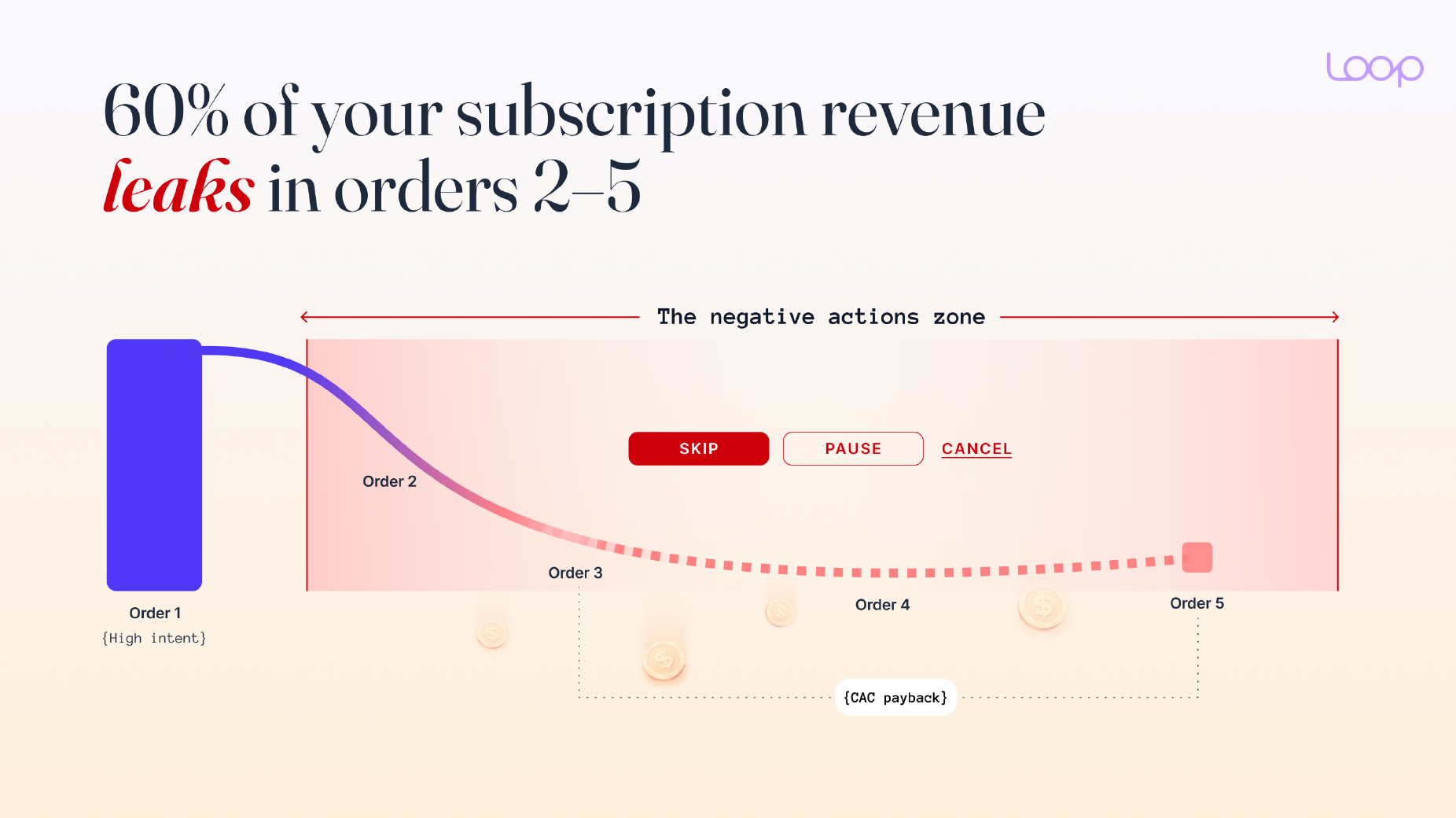
Here’s how the sequence is predictable: a skip becomes a pause → and then cancellation. Each negative action makes the next one easier, because the customer is slipping further away from the habit your subscription was supposed to build.
And the timing could not be worse commercially. For most subscription brands, CAC payback lies somewhere between orders three and five. That means a subscriber who churns at order two was acquired at a loss. If you have thousands of these every week, your whole acquisition model could be in jeopardy.
One measurement note before going further: always look at this by order number, not calendar months. Customers skip and pause, so a subscriber at month three might only be at order one. The month view flatters your retention. The order view tells the truth.
Read: How to Email Active Subscribers to Grow LTV for DTC Subscription Brands
Why don't discounts and win-back offers fix early churn?
Look at where the incentives sit in a typical subscription programme.
There's a discount to acquire the customer. There are rewards for hitting order milestones. There are perks and offers waiting in the win-back flow for anyone who cancels.
But the fundamental gap in this incentive stack is a lack of focus on the primary indicator of long-term loyalty: the habit of ordering on schedule.
Milestone rewards count orders but don’t reward timing. A customer who reaches order four in fourteen months through a chain of skips and pauses collects the same reward as one who got there in four months of consistent use. Only one of those customers has built a habit and only one of them is likely to still be around at order ten.
Win-back offers have a worse problem: they fire after the damage is done. By the time a customer has cancelled, they've usually spent weeks not using the product, accumulated stock they don't need, and mentally moved on. A 20% offer at that point is negotiating with someone who has already left the building.
The gap in the middle - rewarding consistency while the habit is forming - is where early churn actually gets decided.
Read: Why Winback Flows Suck in DTC - And What to do About It
What does consistency in the first few orders actually unlock?
Two things, and they compound.
The first is faster CAC recovery. Fewer skips and fewer pauses mean more scheduled revenue actually gets realised inside the payback window. The same subscriber base, ordering on time, pays back acquisition costs materially faster than one drifting through skips.
The second is the habit loop, and this is the one that determines long-term retention. Consistent orders drive consistent usage. Consistent usage drives better results. Better results create a happy customer. A happy customer stays subscribed.
This matches what we see across retention curves at Magnet Monster. Subscription churn is usually a product adoption problem before it is anything else. The customer who takes the supplement daily, on schedule, experiences the outcome they were promised at acquisition. The customer who lets jars pile up experiences nothing except a recurring charge. No campaign rescues the second customer, because the problem was never the marketing.
Inconsistent ordering reduces how effective the product is for the subscriber besides disrupting your revenue forecast, which is the real reason they eventually leave.
So the strategic question for the first five orders becomes very specific: how do you make placing the next order on time feel like something worth protecting?
Read: What's REALLY Causing Your Subscription Revenue Drop-offs?
How do streaks work as a subscription retention tactic?
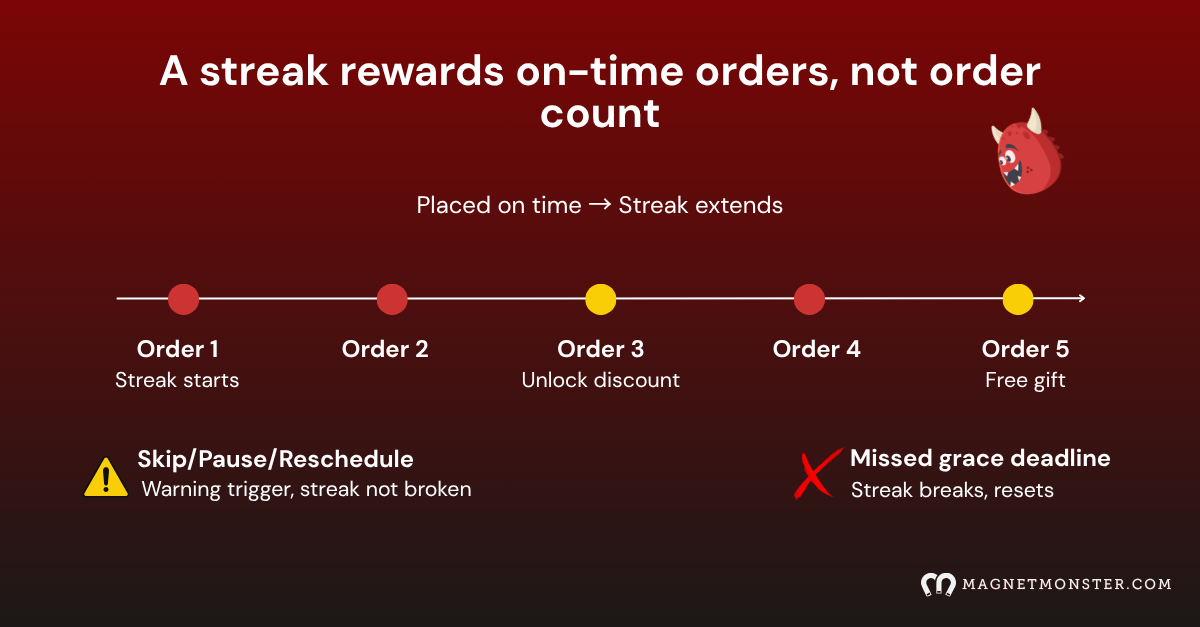
A streak rewards timely placed orders, not order count.
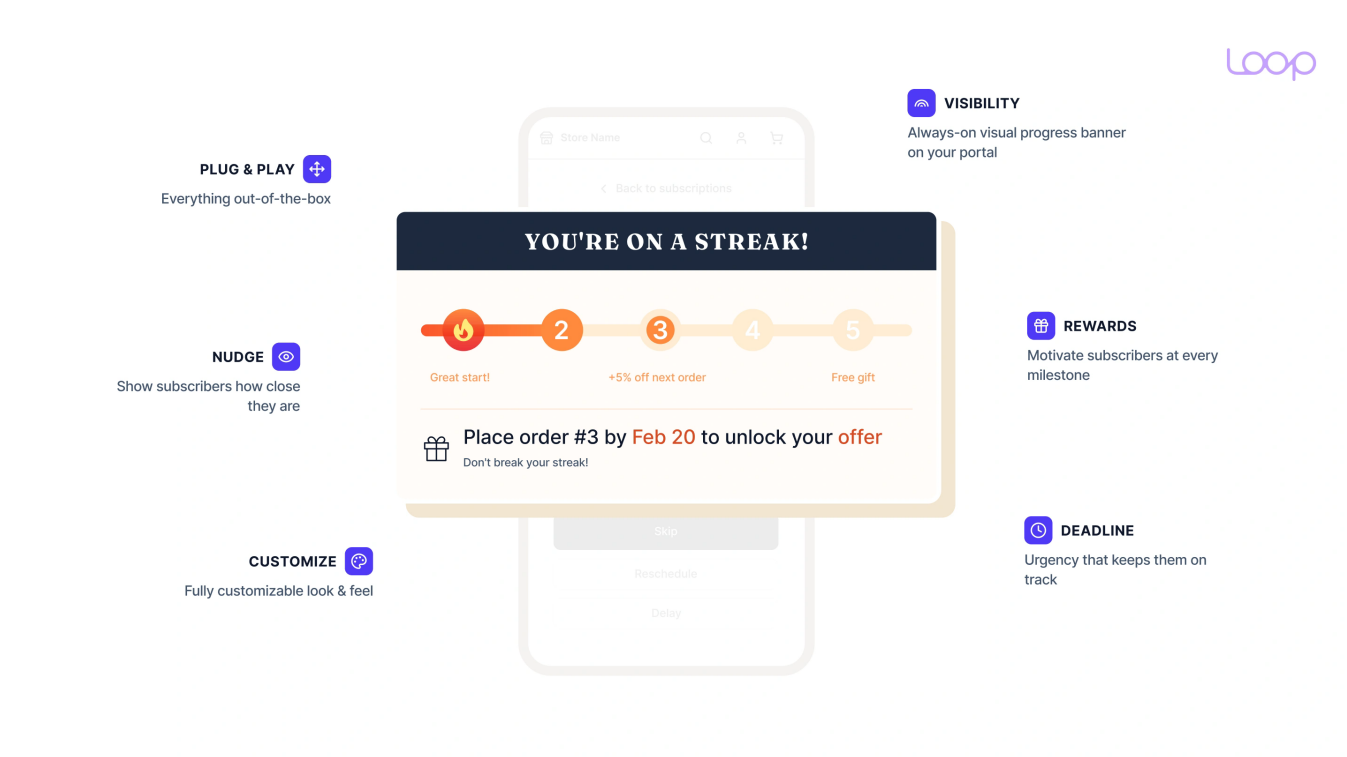
Here's how streaks works:
- Always-on progress banner. From the first order, subscribers see their streak in the customer portal with the next reward in view.
- On-time orders extend the streak. Each order placed by its scheduled date, plus a grace period you configure, moves the customer to the next milestone.
- Rewards at key milestones. A discount at order three, a free gift at order five, or whatever you configure wherever the drop-off risk sits.
- A deadline creates urgency. "Place order #3 by Feb 20 to unlock your offer" → much better than vague loyalty points that urge people to act immediately.
- Negative actions trigger a warning, not a break. Skip, pause or reschedule and the customer is told their streak is at risk.
- Only a missed grace period breaks the streak. No order by the deadline, streak gone, banner reverts to the standard flow.
As enrolment is automatic, Loop adds each new subscriber to the most relevant programme based on product, frequency and selling plan, so there is no signup step to abandon.
Two reasons why this tactic is better than a loyalty scheme:
- The first is accountability with grace. A customer who pushes delivery back a week keeps their progress. A customer drifting towards abandonment gets a clear, well-timed reason to stay on schedule. The streak is designed to forgive real life without forgiving the habit.
- The second is placement. The streak warning lands inside the portal at the exact moment the customer is considering a skip, pause or cancel, which is where 60 to 70% of churn behaviour happens. A retention email arrives hours before or after that decision. The warning arrives during it.
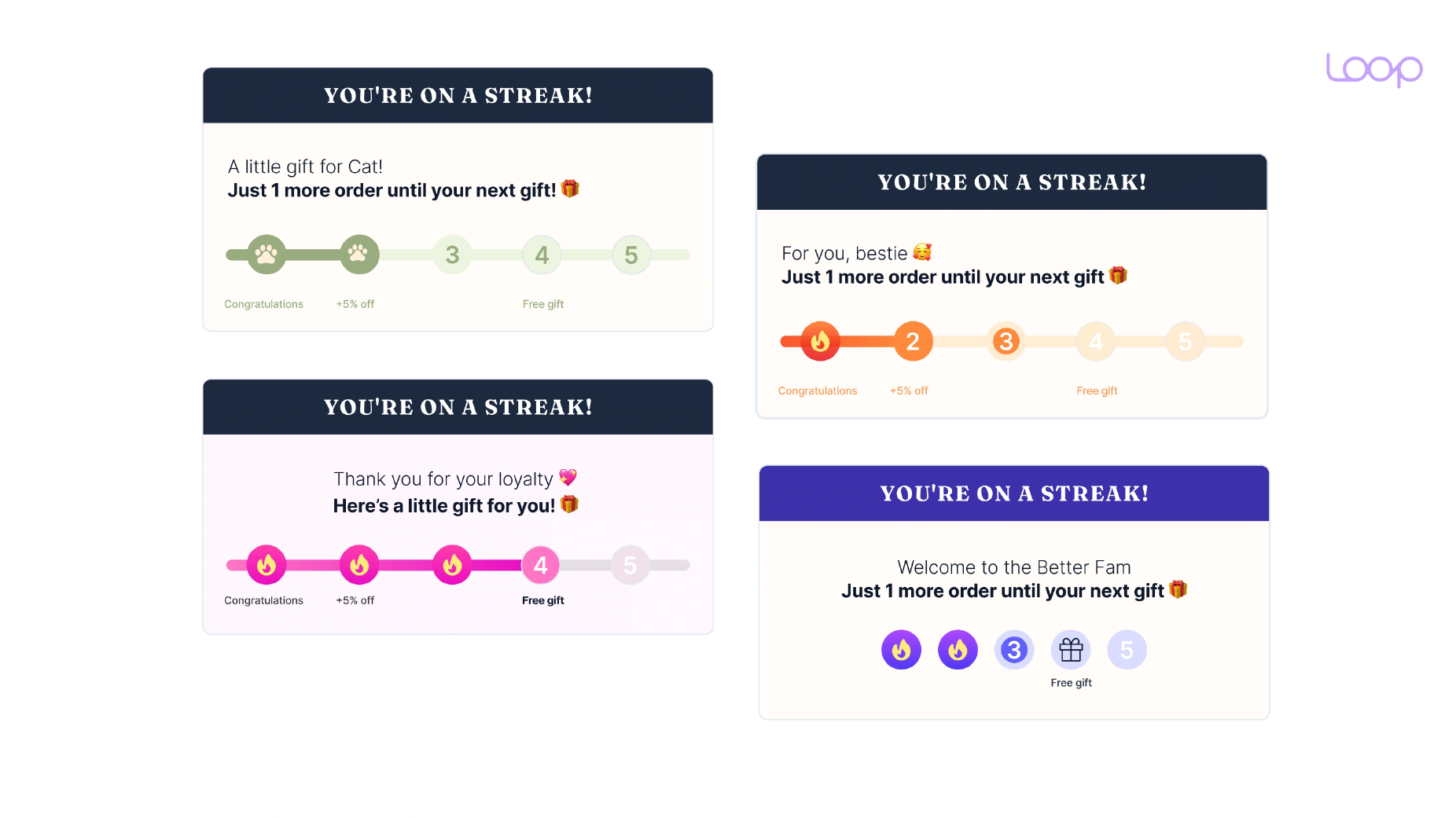
Remember: skipping, pausing or rescheduling does not break the streak by itself. Those actions trigger a warning that the streak is at risk, but the streak only breaks if the order isn't placed within the scheduled date plus the grace period.
What does the data show?
Across Loop's Streaks programmes covering 305,000+ subscriptions and 36,000+ completed streaks, brands running streaks have seen 62% second-order retention and 2x 90-day subscriber LTV.
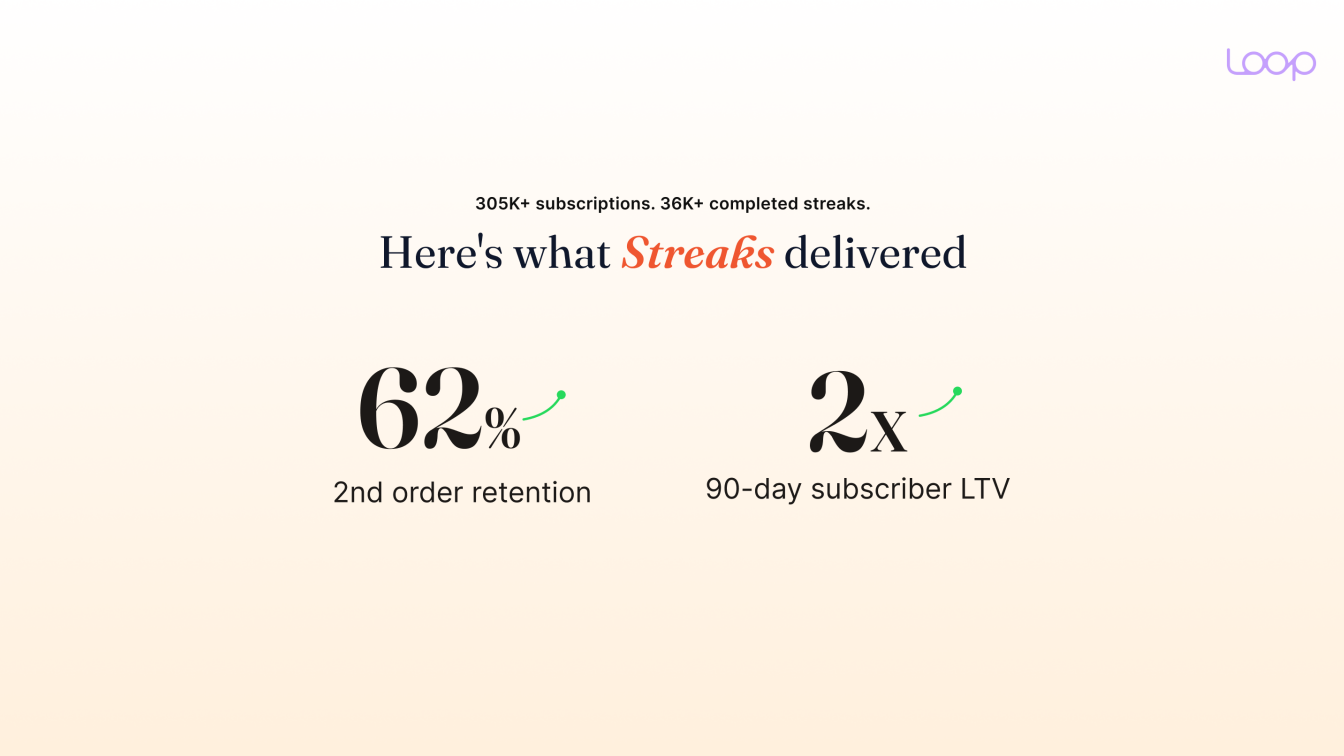
For context: across the wider platform, only 50 to 60% of second orders are even attempted. The gap between those two numbers is the whole argument.
We’ve realised that brands that implement streaks may differ from brands that don't in ways the numbers can't isolate. Treat the figures as a strong directional signal from a large sample rather than a guaranteed lift for your specific brand, and validate with your own testing - Loop's streak analytics include A/B testing between programmes for exactly this purpose.
What the data does establish firmly: consistency in the early orders and long-term subscriber value move together, and a mechanic built specifically to drive that consistency shows results at meaningful scale.
How do you build a streaks programme that actually drives habit?
The setup itself takes minutes inside Loop but what goes into making it work needs some thought. Here's how we'd approach each one.
- Match streak length and grace period to the consumption cycle. A 30-day supplement supports a tighter rhythm than a 90-day supply. Set the grace period generously enough to forgive real life and tightly enough that the schedule still means something. Your goal is on-time usage, not perfect compliance.
- Start with your hero SKU. Enrolment conditions let you build programmes by product, frequency and customer segment. Don’t try to cover your whole catalogue on day one. Around 80% of first-time sales sit on the hero SKU for most brands, so one well-designed programme there covers most of your churn exposure.
- Weight rewards where the cliff is. Rewards are configured per order as a free gift, a discount, or nothing at all. You don't need to reward every milestone evenly. Put the strongest rewards at orders two and three, where the drop-off concentrates, and space them out after the habit stabilises.
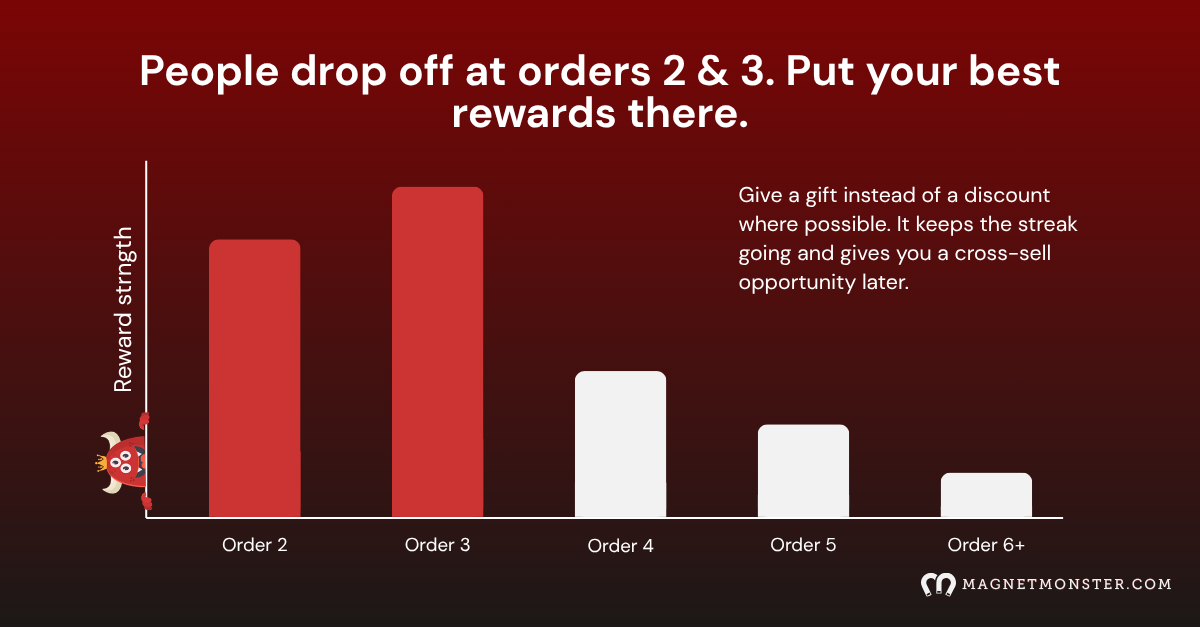
- Use gifts before discounts where margin allows. A low-cost, high-margin SKU as a streak reward does two jobs: it protects the streak and it seeds a future cross-sell. A customer who receives your vitamin D3 free at order three and likes it becomes a candidate to add it permanently. A discount only does one job, and it trains price sensitivity while doing it.
- Build the messaging around it. The streak lives in the portal, but the habit gets reinforced everywhere else. Announce the programme in your onboarding flow. Show streak progress in billing reminders, which reframes them from a charge notice into a milestone update. Nudge near deadlines. The mechanic and the messaging compound each other.
- Watch the order-wise analytics. Loop's streak analytics show progression at each order milestone, so you can see exactly where streaks break. If order three is where programmes consistently fail, that's your signal to adjust the reward, the grace period, or the onboarding that precedes it.
Two operational realities to know upfront: settings lock once a programme goes active (only texts and banners stay editable), so treat the first configuration seriously. And Streaks applies to new subscriptions only, on Loop's Pro plan - existing subscribers don't get retroactive credit for past orders.
Frequently asked questions
How do you reduce subscription churn?
Focus on the first five orders, because that's where churn concentrates. The levers that matter most are onboarding that drives product usage in the first two weeks, billing reminders framed around progress rather than payment, incentives that reward consistent on-time ordering rather than raw order count, and a cancellation flow that responds to the specific objection. Discounts alone don't reduce churn durably, because most early churn is a product adoption problem rather than a price problem.
What is second-order retention and why does it matter?
Second-order retention is the percentage of subscribers who place their second order. It matters because it's the single steepest drop in the subscription lifecycle - across Loop's 1,100+ brands, only 50 to 60% of second orders are even attempted - and because most brands only recover their acquisition cost between orders three and five. A subscriber lost before order two was almost always acquired at a loss.
Does skipping or pausing a subscription break a streak?
No, and this is the detail most people get wrong about the mechanic. In Loop's Streaks, skipping, pausing or rescheduling triggers a warning that the streak is at risk, but the streak only breaks if the order isn't placed within the scheduled date plus the configured grace period. The design forgives a delayed delivery while still holding the customer accountable to the ordering rhythm that builds the habit.
Do streaks work for existing subscribers?
Not retroactively. Loop's Streaks applies to new subscriptions from the point the programme goes live, and past orders don't count towards a streak. For existing subscribers, the equivalent levers are milestone rewards, portal-visible benefits and the cross-sell strategy appropriate to their stage in the retention curve.
Do gamification and streaks actually work for eCommerce subscriptions?
Loop's platform data says yes, with the appropriate caveats. Across 305,000+ subscriptions and 36,000+ completed streaks, brands running streaks have seen 62% second-order retention and 2x 90-day subscriber LTV. This is platform-level data rather than a controlled experiment, so treat it as directional and validate with your own A/B tests, which Loop's streak analytics support natively. The underlying psychology - visible progress plus loss aversion - is the same mechanism that keeps Duolingo and Snapchat streaks alive at enormous scale.
When does a subscription brand break even on customer acquisition cost?
For most subscription brands, CAC payback lands between orders three and five, though it varies with acquisition offer, AOV and margin. That's exactly why churn in the first five orders is so expensive: subscribers who leave before the payback point were acquired at a loss. Measure your own payback by order number and by acquisition offer, then treat everything that drives on-time ordering inside that window as an acquisition efficiency lever, not just a retention one.
Conclusion
Here's what to actually do with this, in order.
Pull up your subscription analytics this week and find your order one to order two conversion, measured by order number. If you're losing more than 40% of subscribers before order two, fix that window first.
Then work out where your CAC payback sits. If it lands at order three or later, every skip and pause before that point is delaying the moment your acquisition starts making money. That reframes consistency from a nice-to-have into an acquisition economics problem.
Then look at your incentive stack with one question: what rewards a subscriber for ordering on time? If the answer is nothing, you know there’s a gap. Whether you close it with a streaks programme, restructured milestone rewards or better onboarding, close it before you spend another dollar on win-back offers that fire after the customer has already gone.
P.S. It takes only five minutes to look at your order #1 to order #2 conversion by order number.
Read: Retention Marketing Strategy: A Practical Playbook by Business Model
Want more of this in your inbox? Subscribe to our newsletter and YouTube channel for weekly DTC retention strategies, extracted straight from the brands we work with. No fluff, just actionable plays.

.svg)


1.png)
.png)