
DTC brands burn six figures a month chasing cold traffic on Meta but leave their existing subscribers untouched.
The truth is your existing subscribers are the cheapest, highest-intent customer base you'll ever have. As CAC climbs, and blended ROAS becomes harder to defend every quarter, the only way to grow your ROI is what you do with the customers you've already paid to acquire.
In this joint piece, Brice Douglas, Piyush Jain, Hattie Gilpin & Adam Kitchen share the 4-play playbook for scaling subscriber LTV — covering customer portal upgrades, interactive AMP email, signal-based targeting, and lifecycle automation that ties it all together.
If you're running subscription brand, this article gives you the operator-level frameworks to extract more LTV from the assets you already own without touching your ad spend.
Introduction
The highest-LTV customer you'll ever have is already paying you. Most brands do nothing with them.
Most DTC brands burn six figures a month chasing cold traffic on Meta, then treat their existing subscribers like back-office plumbing — something to bill, ship, and pray doesn't cancel.
It's backwards. CAC isn't going down. Blended ROAS is getting harder to defend every quarter. The only lever left with compounding returns is what you do with the customers you've already paid for.
A subscriber with a card on file is much easier to sell to than a cold prospect on a UGC ad. They’ve already trusted you with their address and card details. Every upgrade, add-on, and frequency change you don't ask for is revenue left on the table.
This article is a joint piece from four operators who spend all day figuring out how to pull that lever — across the surfaces where subscribers actually pay attention:
- Play 1 — Piyush Jain, CEO of Loop Subscriptions, on turning the customer portal into a proper upsell and upgrade engine.
- Play 2 — Brice Douglas, CEO of Zaymo, on using interactive AMP email to let subscribers upgrade, add, and reactivate in one click — without ever leaving the inbox.
- Play 3 — Hattie Gilpin, Director of Operations at Wellbel and co-founder of HAM (a subscription analytics platform), on reading the subscriber signals that tell you who to upsell, when, and with what.
- Play 4 — Adam Kitchen, CEO of Magnet Monster, on the email campaign strategy and automation architecture that ties it all together.
Why subscriber upsells are the highest-leverage LTV lever in DTC
By Adam Kitchen, Magnet Monster
LTV is a function of frequency × AOV × margin × lifespan. A well-executed upsell moves three of those four variables at the same time — without spending a penny on acquisition.
Compare that to the tactics most brands actually run: deeper discounts at the cancel button, "WE MISS YOU" winback flows that nobody opens, and Black Friday sales that erode margin and train the base to wait.
One is a compounding asset. The other is a leaking bucket.
The brands winning today have built a system where every subscriber surface: portal, inbox, automation is quietly asking a better question at the right moment.
Play 1: The customer portal is your most underused upsell surface
By Piyush Jain, Loop Subscriptions
Your customer portal is the highest-intent surface in your entire subscription funnel.
Here’s who is actually there:
A logged-in, paying subscriber who navigated into their account on purpose:
- To manage an order
- Update a card
- Change the frequency.
They’re warm, authenticated, attentive. You couldn't buy this audience on Meta for any price.
And yet most brands treat the portal like a utility bill.
When we built Loop, we designed it around a simple thesis: the subscriber who's in their account this week is the easiest person in the world to upgrade, extend, or expand. Two plays do the heavy lifting.
Play 1a: Upgrade monthly subscribers to multi-month supplies
Every brand has a cohort of monthly subscribers who'd happily move to a three or six-month supply if you asked them properly. Most brands just never ask.
In Loop, the ask lives as a targeted banner in the portal. Click → Confirm → Done.
The plan is upgraded instantly at an incremental discount layered on top of their existing subscription rate.
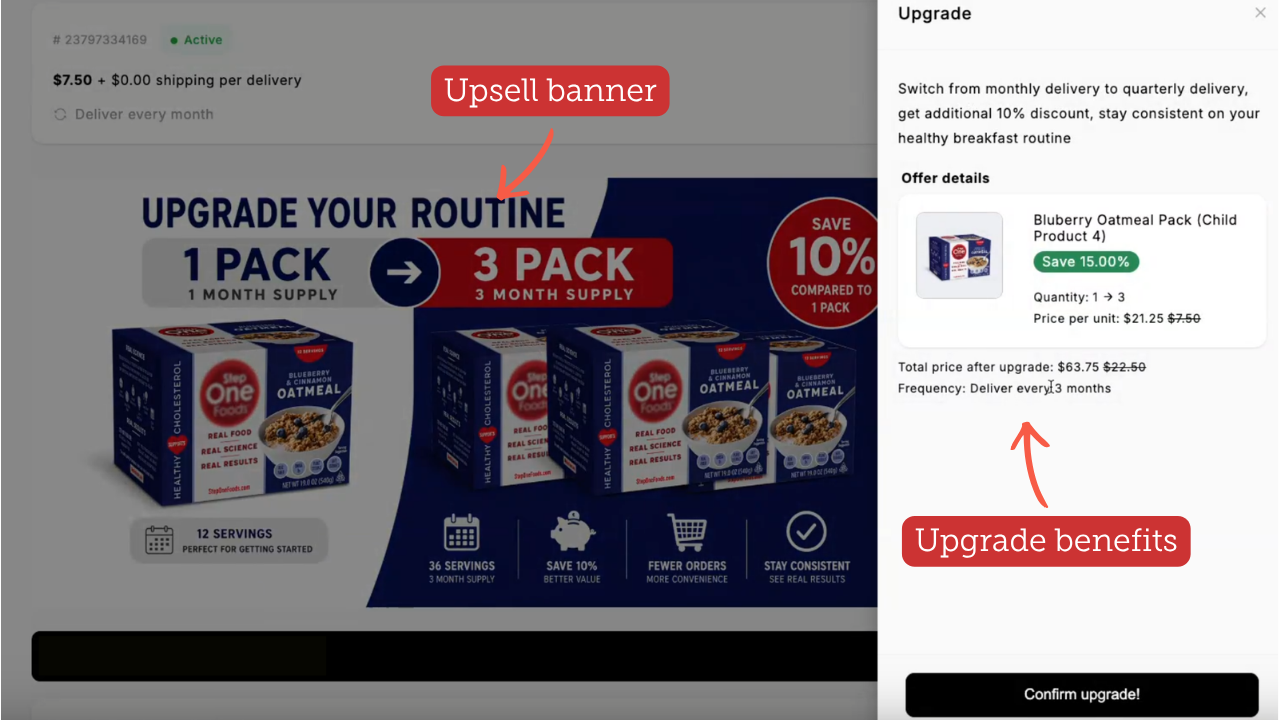
Here’s how brands can upsell offers via Loop’s backend:
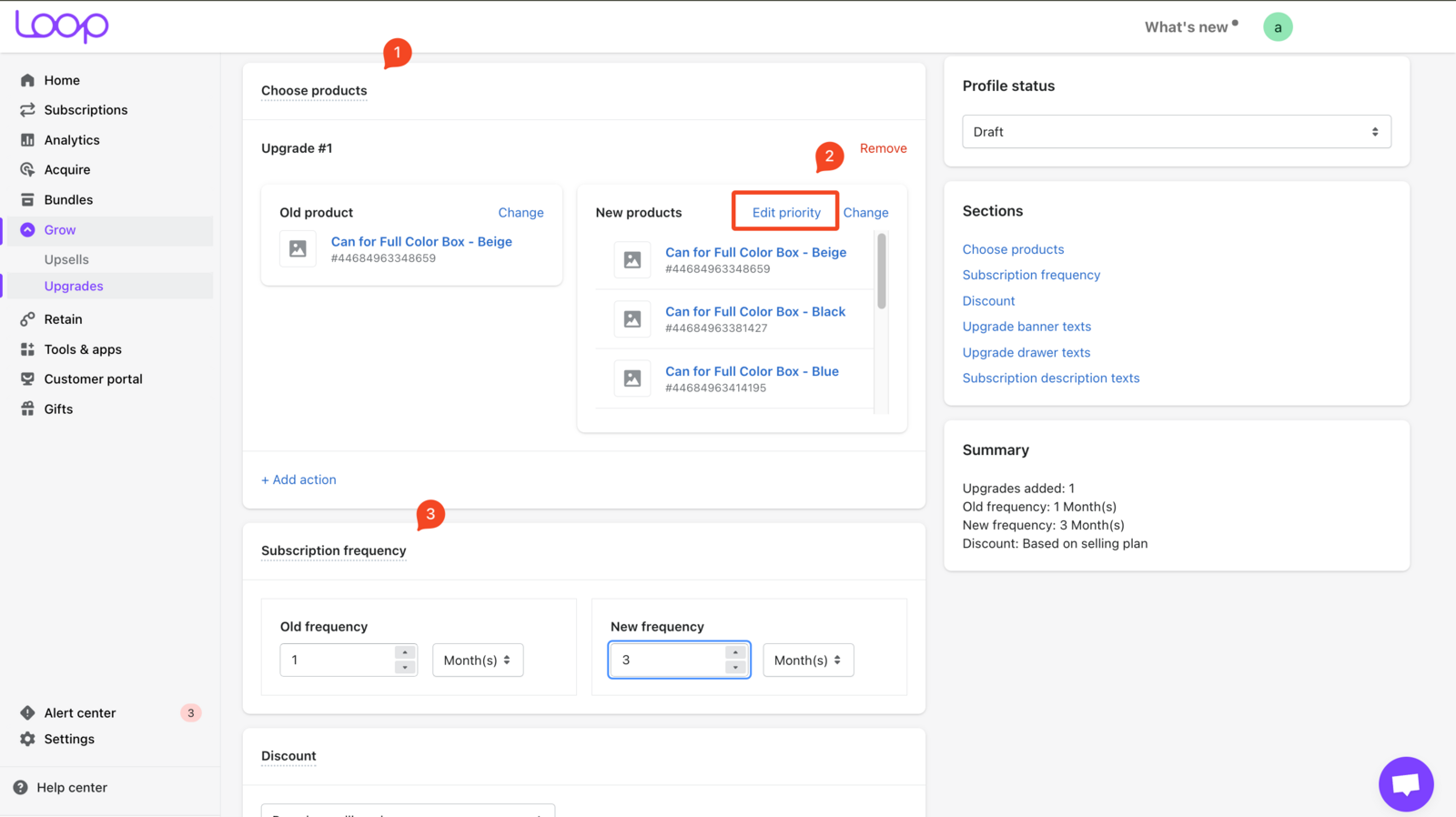
The economics are obvious:
- Lifespan extended (3-6 months of revenue committed in one transaction)
- AOV lifted on that order
- Churn risk neutralised for the covered window
All for a discount that costs margin on one cycle and buys retention on six.
Play 1b: Surface contextual upsells based on routine
The second play is a contextual strategy:
- What routine is this subscriber already building with you?
- And what's the obvious next product in it?
For example, a customer on an oatmeal pack isn't a candidate for whatever's trending on the site. They're building a healthy morning routine. The right upsell is healthy lunch or snack SKUs that complete the pattern — as a one-time add to the next order, or a second subscription at a bespoke discount.
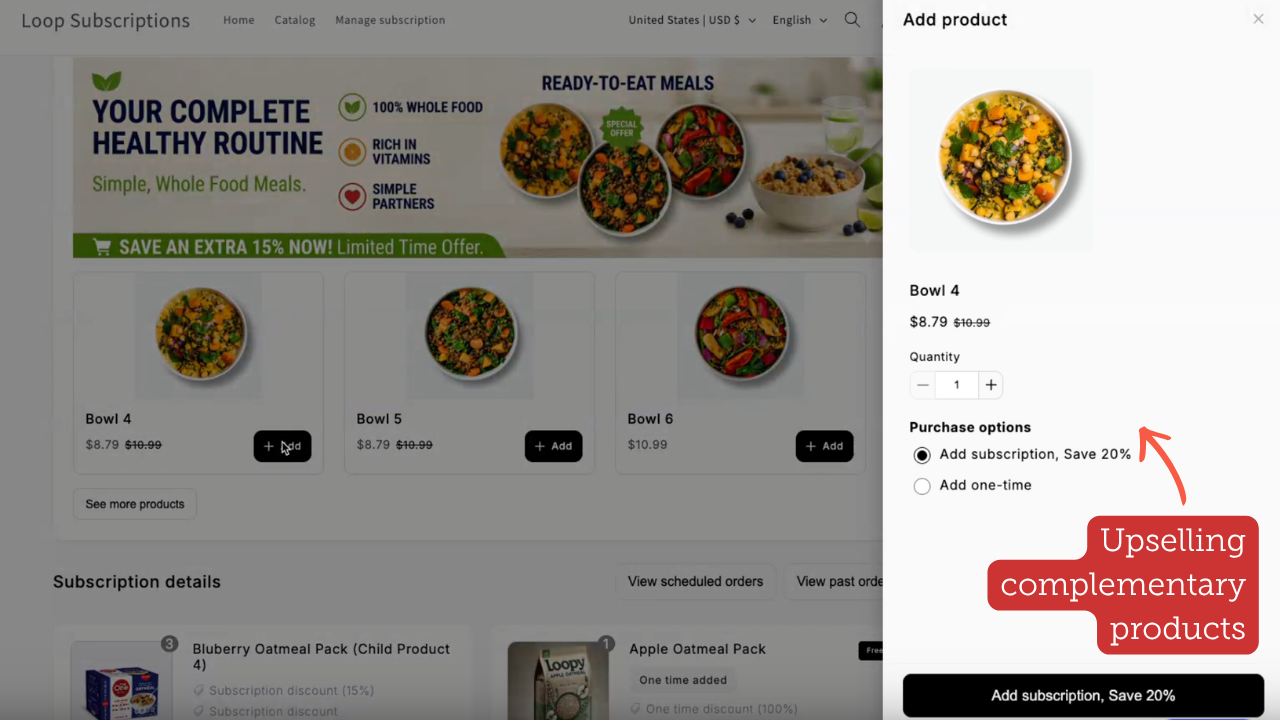
In Loop, brands can configure this in their backend as upsell profiles with real conditional logic such as:
- Product held
- Order history
- Spend tier
- Country
- Bundle type
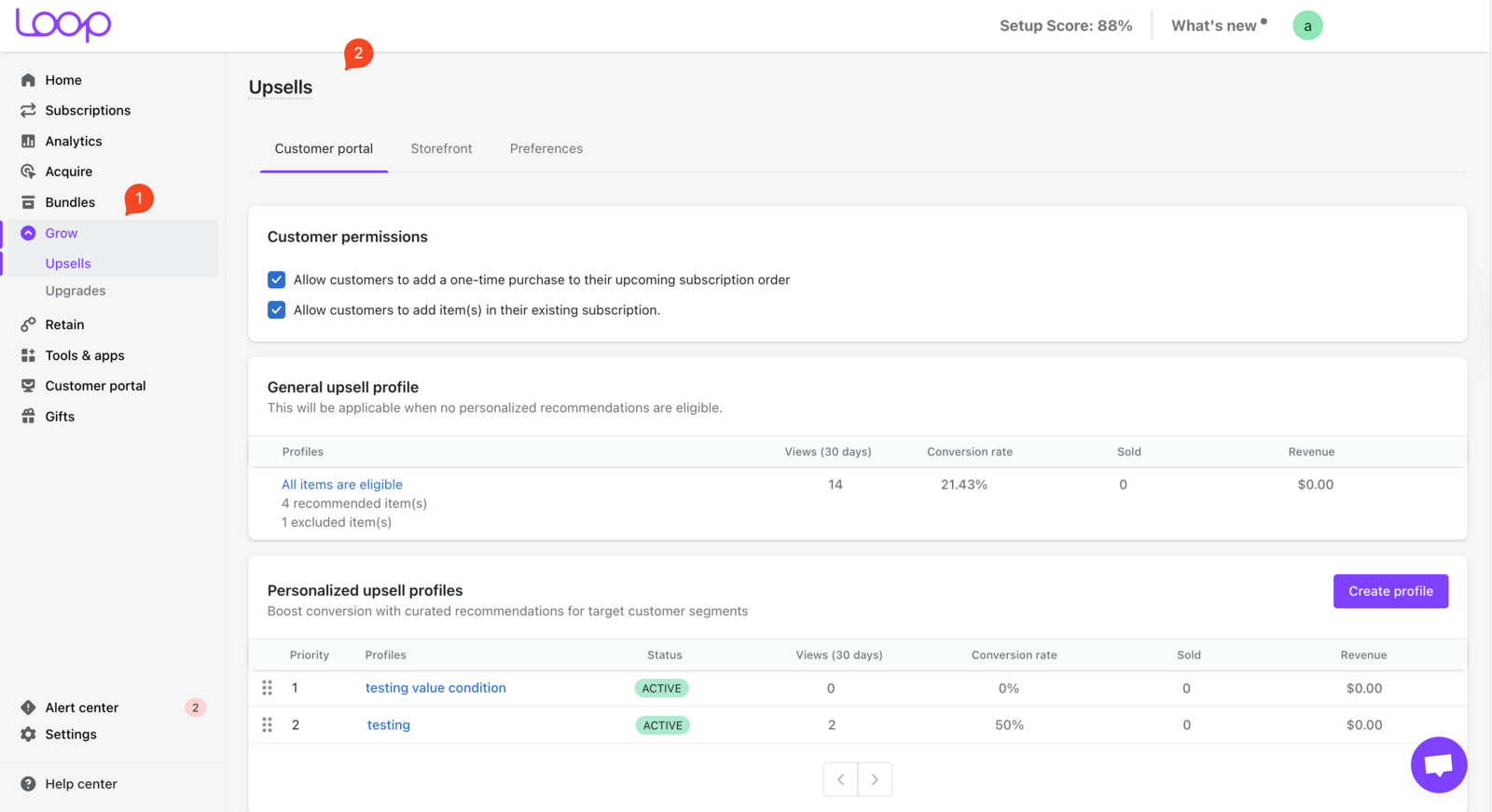
You define who sees what (e.g. "Healthy Routine" → US subscribers to SKU X with >$200 LTV), set the display (curated list, tag-driven dynamic feed, or auto-refreshing best-sellers within a category), and set a discount structure independent of the core subscription's selling plan.
3 rules for getting this right
- Don't blanket the base - A 6-month subscriber doesn't need the same banner as a Day-14 first-timer.
- Price the upgrade like you mean it - Deep enough to justify the commitment, shallow enough to protect long-term margin.
- Measure incremental LTV, not upsell revenue. The question isn't "how much did the banner generate this month?" — it's "what's the 12-month LTV delta between the upsell cohort and the control?"
Bottom line: Portal upsells are a conversion surface you've already paid to build. Use them accordingly. (For more on the email side of the Loop integration, see our earlier piece with Piyush: 6 Powerful Emails to Engage Your DTC Subscribers.)
Play 2: Move the upsell into the inbox with interactive email
By Brice Douglas, Zaymo
Most subscribers spend more time in their inboxes than in your portal. Yet most DTC brands have no idea how to engage them there.
You can build the best in-portal upsell in the world, but if the subscriber only logs in once every four months to update a card, you're missing ten touchpoints in between.
Traditional ecommerce email is a redirect machine: open → click → land on site → navigate to product → select variant → add to cart → check out.
Six steps, six drop-off points, and a conversion rate that tops out at 1–3% on a good day.
With AMP and interactive email, those six steps collapse into one. The subscriber acts inside the email. Zaymo integrates natively with Loop, Recharge, Skio, Stay AI and the major subscription platforms, so every action (upgrade, add-on, accelerate, swap) ties back to the subscription in real time.
Four plays do most of the work.
Read: How to Simplify Online Shopping with Interactive Emails
Play 2a: One-click upgrade to a bundle or larger SKU
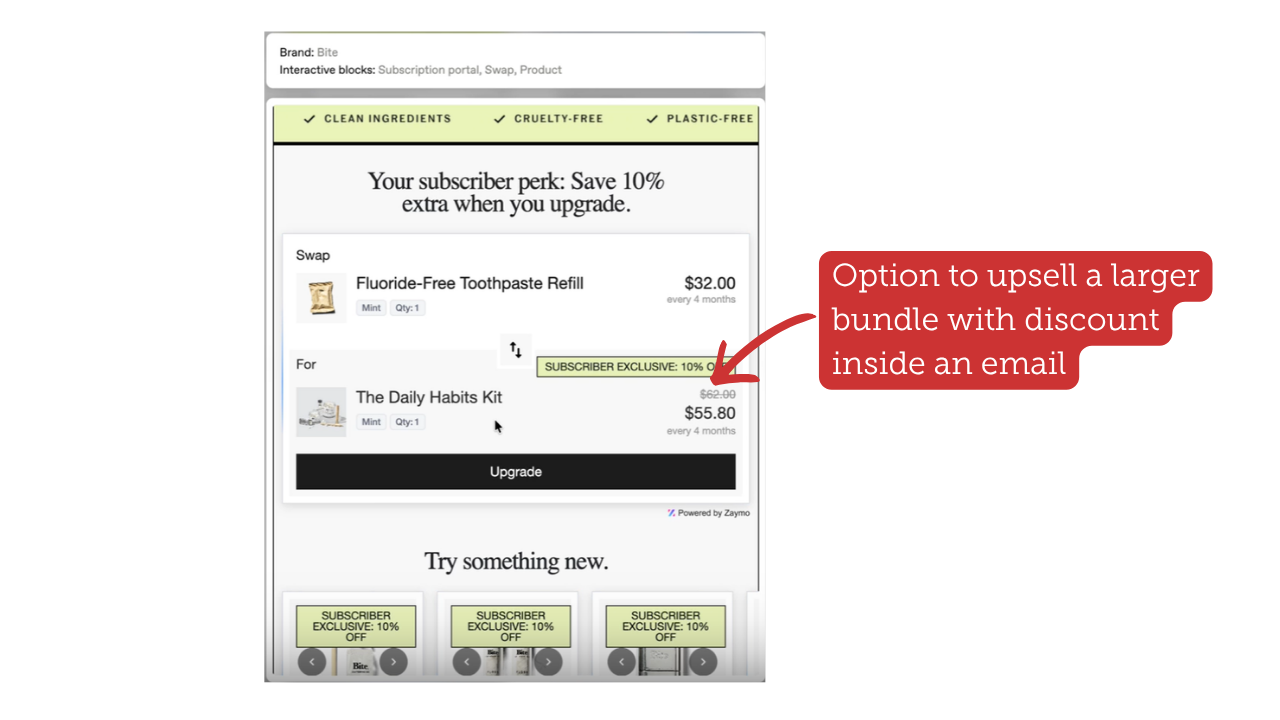
Spot a subscriber on a single-product refill, and serve them a bundle upgrade at the same cadence with an auto-applied discount baked in.
The example we run with a fluoride-free toothpaste brand: subscriber is on the toothpaste refill, the email offers an upgrade to the full kit at 10% off. One click, same delivery cadence, higher AOV. No portal visit, no cart, no checkout.
Play 2b: One-click cross-sells into the next order
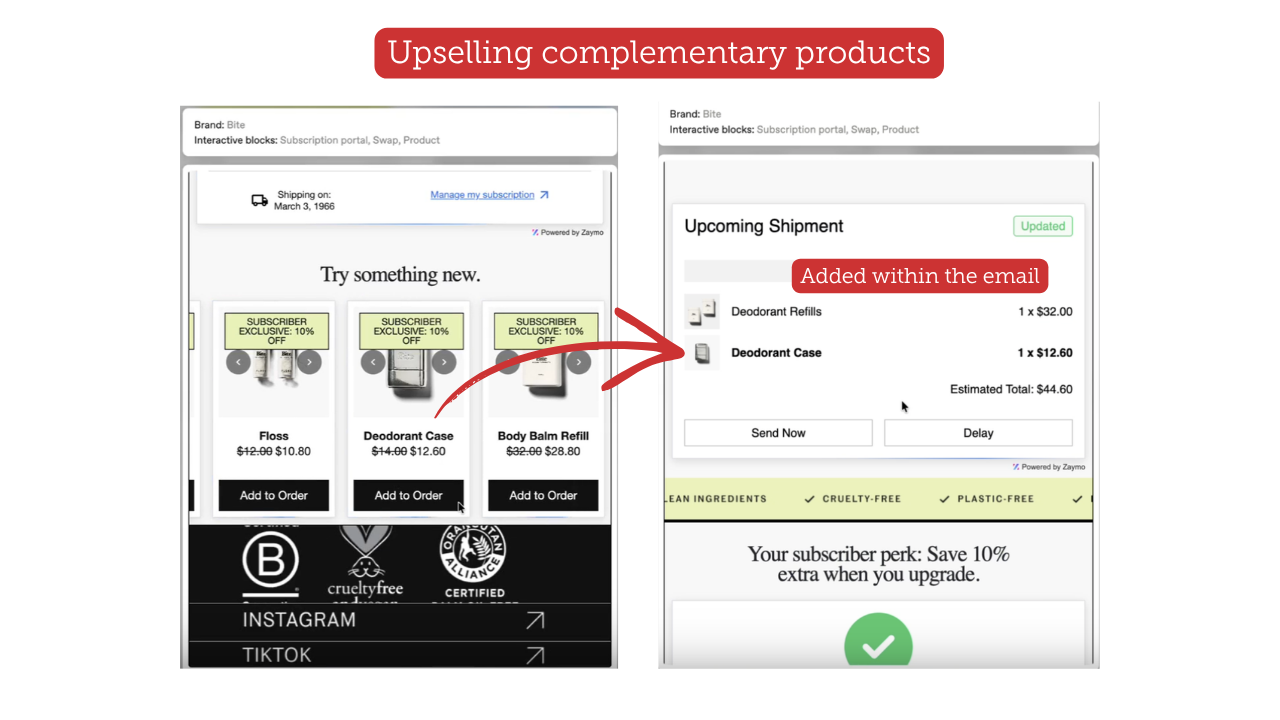
Instead of asking the subscriber to go to the site and start a new subscription, you present a complementary SKU directly in the email that’s live-connected to Shopify and the subscription platform with a subscriber-exclusive discount.
One click adds it to their next scheduled order. No shipping cost to absorb (it ships with the existing subscription), no re-acquisition cost, no friction. You even have an undo button in-email, because at that level of speed, people change their minds.
Play 2c: Accelerate the next order
You can increase the LTV by pulling the next order forward.
For example, a pre-charge reminder five days out, a holiday gifting nudge, a "running low" prompt. Let the subscriber accelerate their next shipment in one click, right in the inbox. Every acceleration pulls subscription revenue forward and compounds annual order frequency.
Play 2d: Upgrade to a longer cycle (1-month → 3-month, 3-month → 6-month)
Same mechanic as Loop's portal upgrade play — executed on the surface where subscribers actually spend time.
Everyday Dose runs this inside campaign emails: one-click upgrade from a 30-day cycle to a 90-day cycle.
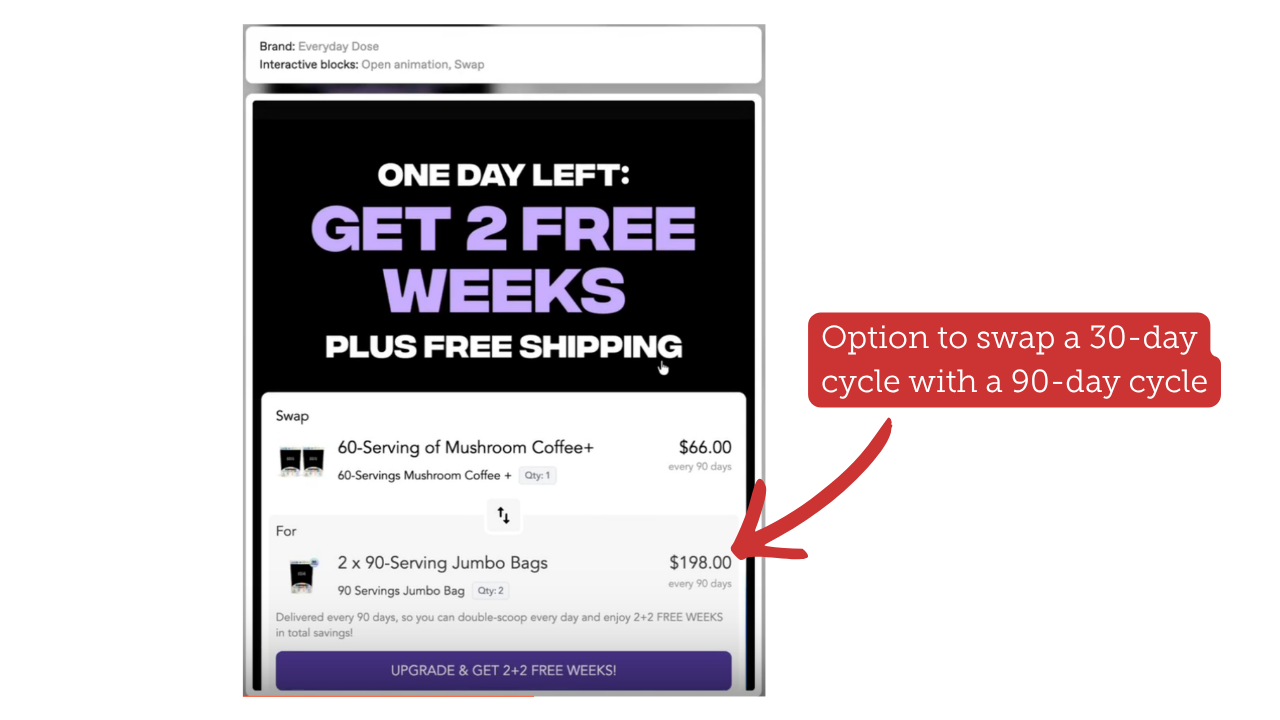
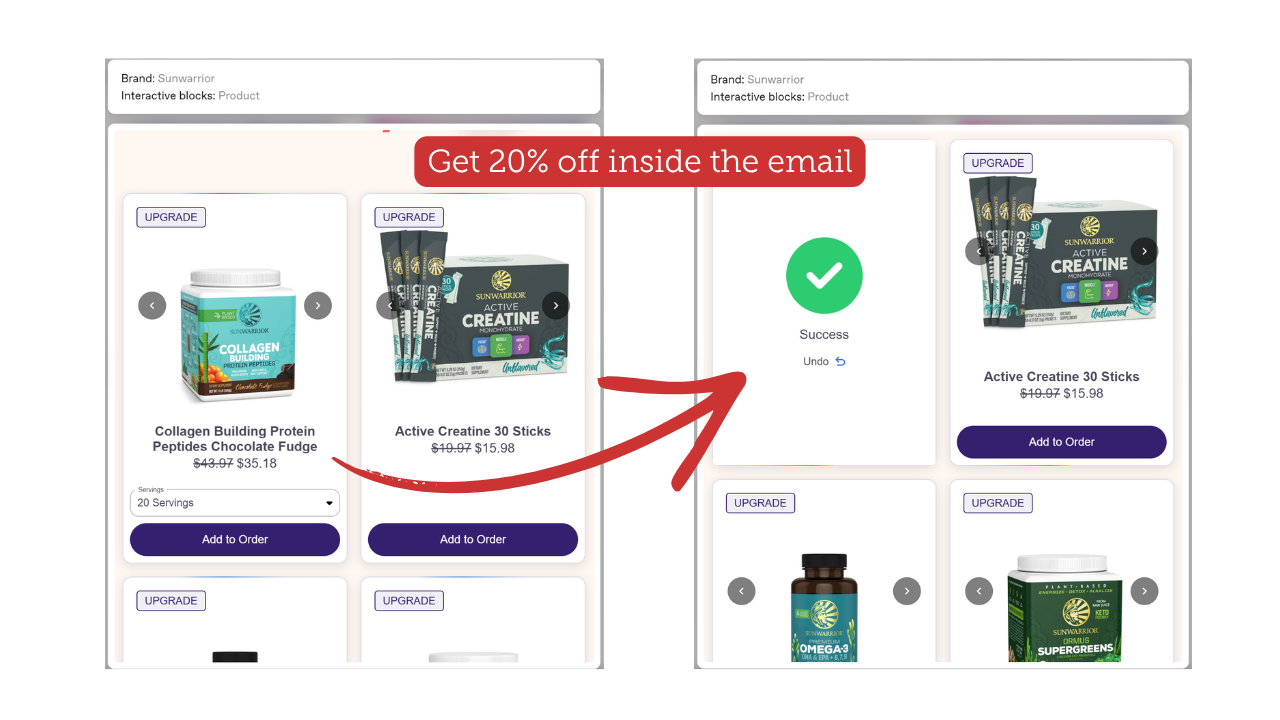
Sunwarrior runs it as a subscriber-perk callout with 20% off, embedded in regular campaign sends. Both motions quietly extend customer lifespan without requiring the subscriber to ever leave the inbox.
How to kill churn with in-email order editing
Some of the biggest lifts in LTV come from letting subscribers adjust instead of cancel.
Mosh lets subscribers swap flavours inside the email. For example, swap peanut butter chocolate chip with hazelnut chocolate chip directly inside the email. A subscriber who's bored of their current flavour and would've churned now swaps to something new and stays.
The same mechanic handles frequency changes. A subscriber who feels they're getting too much product would normally cancel; in-email editing lets them stretch the cadence to every two months and stay subscribed.
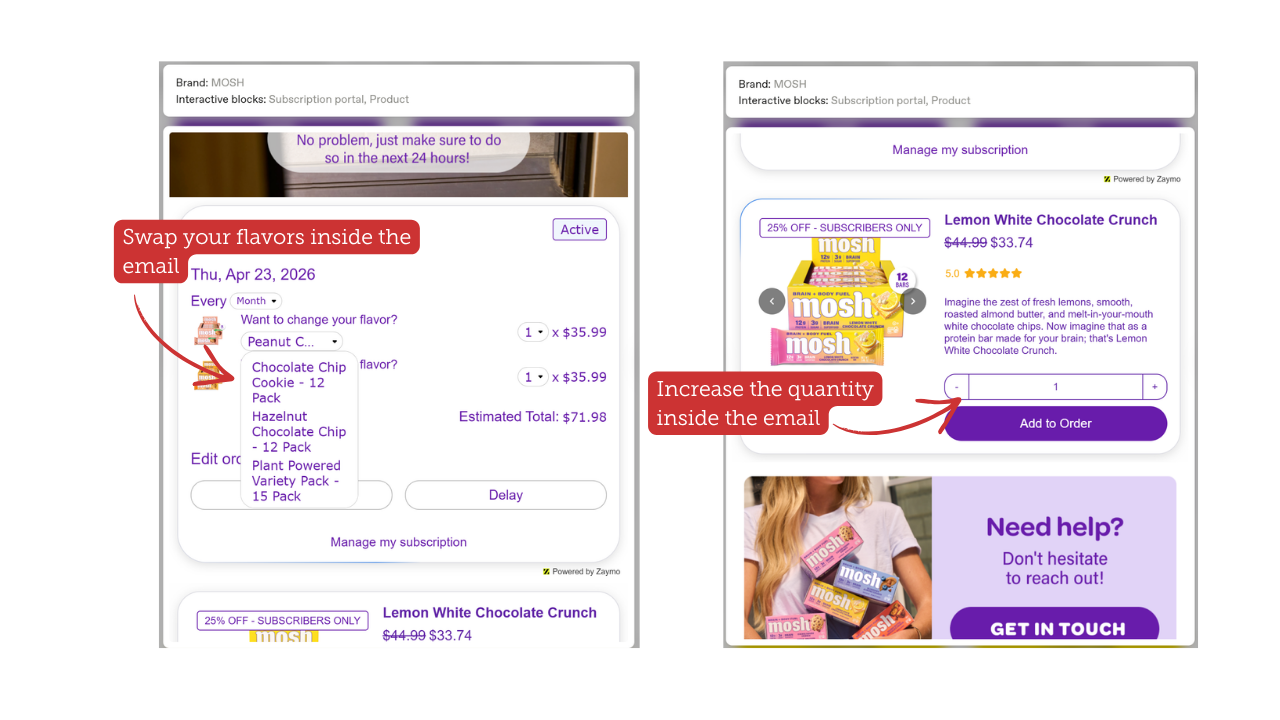
Both are positive actions you're making effortless. Both translate directly into retained LTV.
3 rules for getting this right
- Build for the one-click action, not the click-through. If the subscriber has to leave the email to complete the motion, you've already lost most of the lift.
- Integrate with your subscription platform natively. In-email upgrades, swaps, and accelerations only work if the action writes back to the subscription in real time.
- Track interactions, not just clicks. When the action happens in-email, traditional click-through rates understate performance. Measure interaction events and attributed revenue per send.
Bottom line: Use the inbox as an interface. Brands that start treating it like one are the ones extending LTV without touching their ad spend.
Play 3: Read the subscriber signals that tell you who to upsell, when, and with what
By Hattie Gilpin, Wellbel & HAM
Piyush and Brice have given you the surfaces. The next question is who you should be deploying these upsells to, when, and with what offer. That's a signals problem. Something we find ourselves talking through with brands a lot is how to think about upselling existing subscribers in a way that actually moves the needle on LTV. A few strategies we've seen work:
Play 3a: Upsell the billing cycle based on behaviour, not time
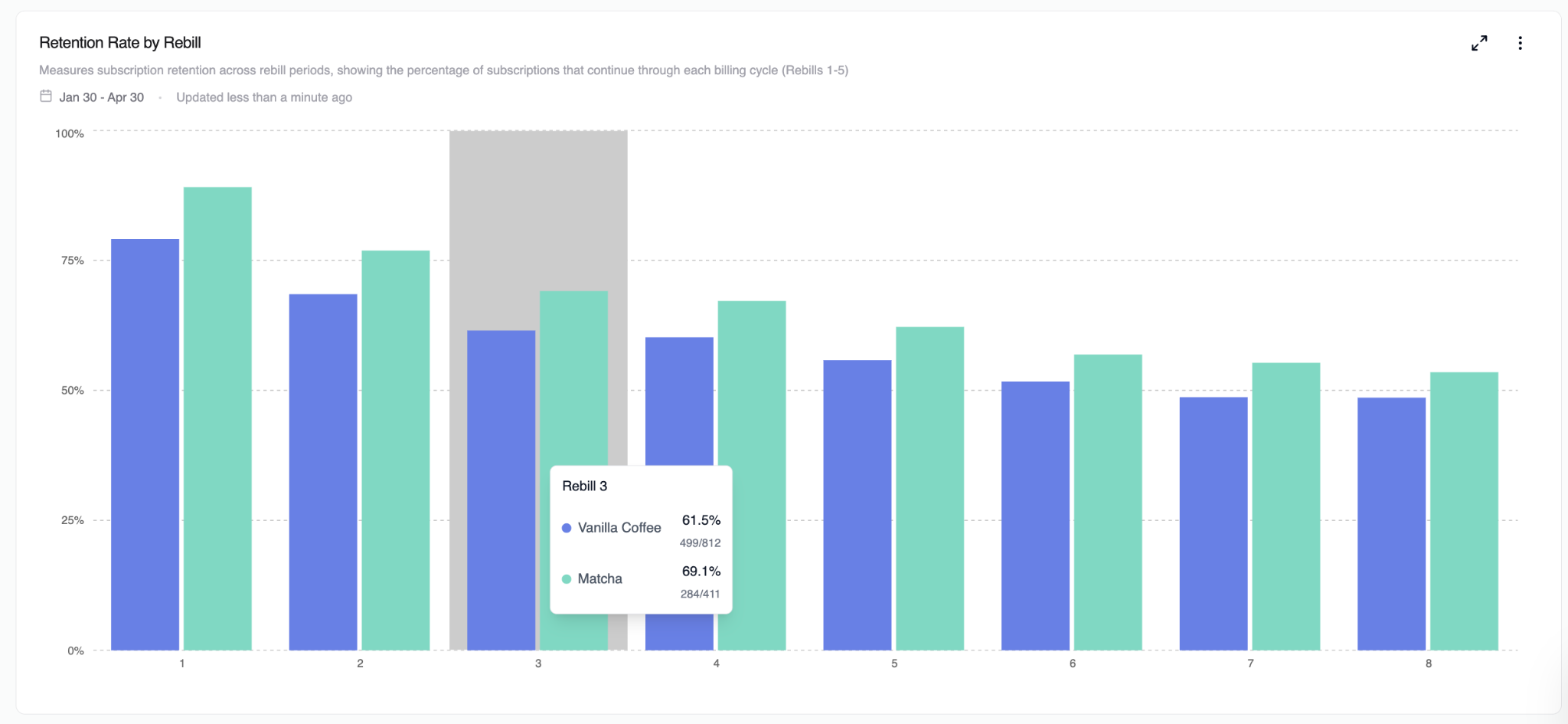
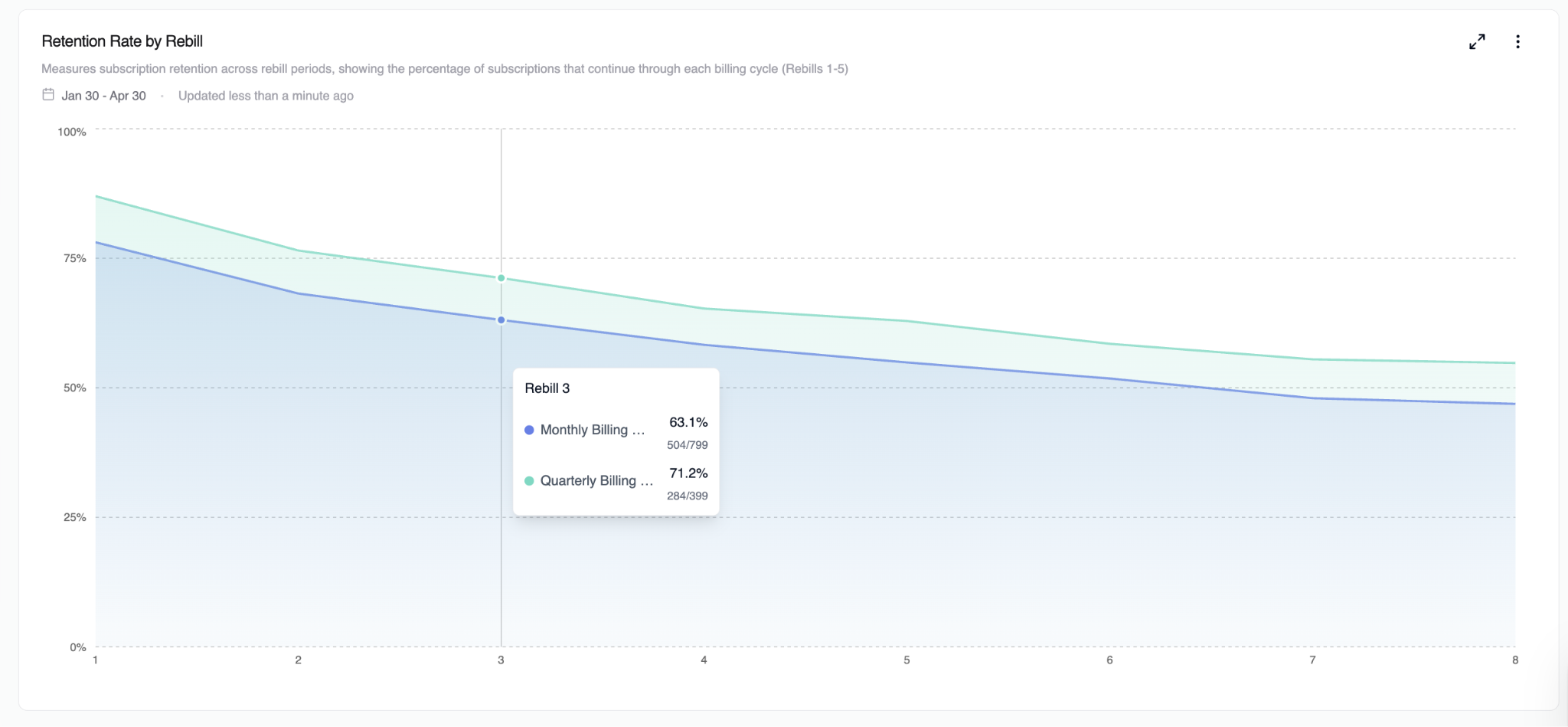
A subscriber who has billed consistently with no skips or pauses is a fundamentally different candidate than someone who has paused twice. Waiting for that clean billing signal, typically around 60 to 90 days, before making a cycle upgrade ask is primarily a lifespan play. You are locking in more of the customers you already paid to acquire.
Read: How to Reduce Churn and Boost Engagement in D2C Subscriptions ft. Matthew Holman
Play 3b: Let swap behavior tell you what to offer next
When a subscriber starts swapping products they are engaged and exploring. That is the right moment to introduce a complementary product or bundle. This is an AOV and frequency move, adding more to the order without touching lifespan.
Play 3c: Use your starting product as a predictor
In HAM we look at what subscribers historically add on based on which product they came in on. If customers who start on product A consistently add product B around order 3, that is a playbook you can get ahead of. This moves AOV and frequency without any guesswork.
The common thread is that knowing when and what to offer matters as much as the offer itself. That is what we built HAM to surface, so brands can act on subscriber signals rather than blast their whole list and hope.
Read: (10-Step Playbook) Churn Prediction Email Strategy for eCommerce Brands
Play 4: Build the email campaign strategy that ties it together
By Adam Kitchen, Magnet Monster
Piyush, Brice and Hattie have given you the surfaces and the signals. The last piece is the email strategy that brings it all together. To do that, I first need to address the biggest misconception in subscription marketing that is costing you millions of dollars in incremental revenue: that you cannot and should not email your active subscribers.
This line of thinking is misleading and is built upon a poor understanding of subscription economics. (For a full breakdown of how to think about retention strategy across the customer lifecycle, see our Retention Marketing Strategy Bible for DTC Brands.)
The rationale behind it is that emails cause active subscribers to churn by reminding them of their recurring payments. Every touchpoint is perceived as a churn risk rather than an opportunity.
There is nuance to this, however. For most brands, approximately 70% of churn happens between orders 1-3; when the habit hasn’t been formed, and scepticism remains high. It’s logical to abstain from heavy marketing campaigns during this period as the product isn’t entrenched in the customer's lifestyle and routine.
However, after order 3, things start to shift quite dramatically. Churn stabilises across cohorts, and your attention needs to shift accordingly. These are customers who have generally built a habit, are happy with their subscription and stable. Your primary focus should shift from churn prevention to increasing recurring AOV.
The reason most subscriber upsell campaigns underperform is that brands blast the same offer at their entire base and call it segmentation. They don't.
Real segmentation means knowing when and what to offer. That matters as much as the offer itself. As Hattie mentioned in Play 3, the only way to get it right is to read the signals your subscribers are already giving you.
Strategic segmentation for active subscribers
Here’s an example of how you could adapt this targeting for let’s say, a kids supplement brand that emails their subscriber base 4 times per week.
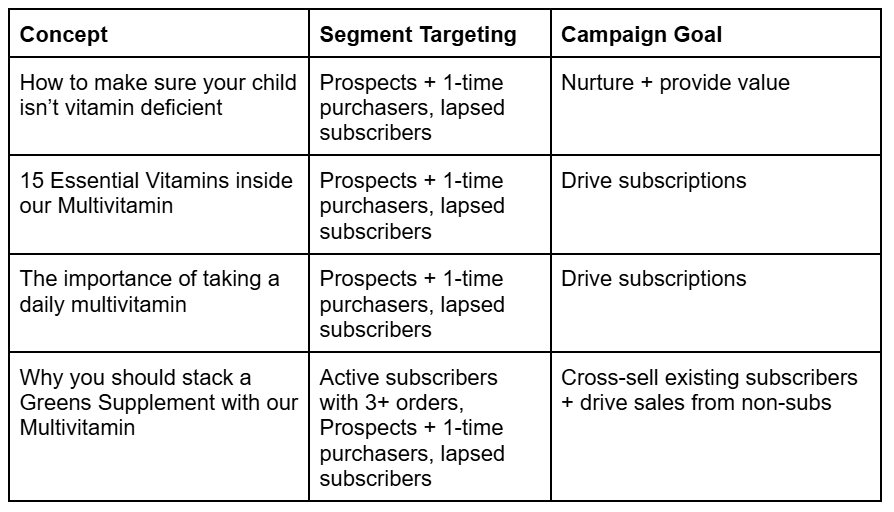
So yes, you can still email your active subscribers – you simply need to reduce the frequency and be more strategic about your sends + segmentation strategy.
Read: How to Save an 8-Figure DTC Brand with Retention Marketing
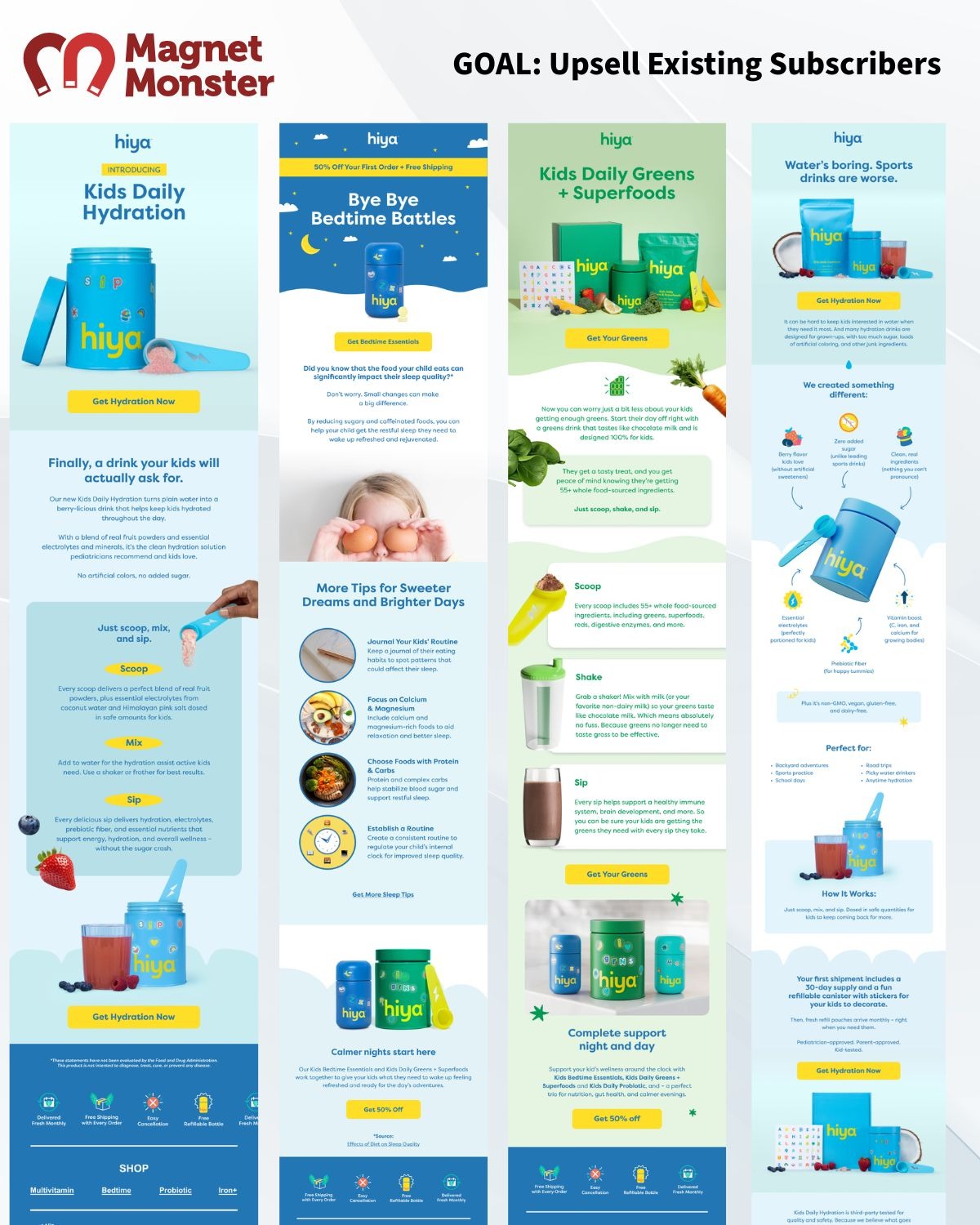
Here are some examples of how we’ve put this into practice for our clients with cross-sell campaigns:
Conclusion
Four plays. Four operators. One subscriber.
Do not treat the portal, the inbox, and the campaign calendar as separate channels — they're the same conversation with the customer you've already paid to acquire. Stop blanket-discounting. Start reading signals. Upsell on behaviour, not time. Operate every surface.
That's how you scale LTV without touching your ad spend.

.svg)


1.png)
.png)