The single biggest lever for increasing AOV and customer lifetime value on a Shopify storefront is the cart, checkout, and post-purchase moment - the highest-intent seconds in the entire customer journey. Fix this layer and you multiply the return on every email and SMS touchpoint sitting above it. But if you ignore it, you're burning your retention budget even before the customer ever subscribes.
I audited a brand last month with a neatly segmented Klaviyo account and a 6-flow post-purchase journey.
Their AOV (Average Order Value) hadn't moved in 14 months.
Ben Sharf, co-founder of Platter - Shopify Platinum Partner, 200+ storefronts built, over $1bn in GMV across their client book - told me exactly why.
They were optimising the wrong page entirely.
Why AOV doesn't move no matter how good your email strategy is
Here are two uncomfortable truths about LTV that most retention marketers won't tell you.
- Truth 1: you can have a perfectly segmented list, flawless flows, and a campaign calendar running like clockwork, and your AOV still won't budge.
- Truth 2: the ceiling on what that customer will EVER spend with you gets set before the email even lands in their inbox.
I've said this before: retention can't fix a broken product.
The same law applies one layer down.
Retention can't fix a storefront that's quietly leaking margin on every single order, no matter how good your segmentation strategy is.
So I sat down with Ben and the team at Platter to understand the single highest-leverage lever they pull for clients, and why it consistently outperforms almost anything an email marketer can do.
Where does the checkout sit in the retention hierarchy?
The checkout sits below remarketing but above most flows in the retention hierarchy I talk about constantly:
- Acquisition quality
- Product and offer fit
- Category purchase latency
- Post-purchase experience
- Remarketing touchpoints (email, SMS, WhatsApp, direct mail)
Most retention agencies focus exclusively on layer 5.
The storefront - cart, checkout, and the post-purchase moment - sits upstream of it, in the same territory as offer fit and post-purchase experience. Which means it decides what layer 5 has to work with.
If you fix it, you could reap big rewards from every flow and campaign sitting below it. But if you ignore it, and you're pouring email budget into a funnel that was leaking value before the customer ever subscribed.
Most agencies and marketers never look here.
They're staring at Klaviyo dashboards, chasing vanity metrics like Revenue Per Recipient, obsessing over segmentation permutations, while the single highest-intent moment in the entire customer journey - the second after "Buy Now" gets clicked - goes completely unoptimised.
Ben Sharf says, “Every dollar you spend on remarketing is trying to manufacture intent. The second someone clicks Buy Now, the intent already exists. We've built over 200 storefronts and it's the same story almost every time, the checkout is some of the most valuable real estate in the funnel and most brands never do anything with it."
Don’t miss: How to Increase AOV for DTC Brands: The Cohort-Led Playbook (With Ben Sharf, Platter)
What does Platter actually do for Shopify brands?
Platter is a Shopify Platinum Partner, the top tier of Shopify's agency programme. Their work splits into two buckets: Build (new stores and migrations) and Improve (optimising what's already live).
The Improve side is where this lever lives.
How does gamifying the checkout increase AOV?
Three principles drive it.
1. Reduce the friction between "I want this" and "I've bought this."
2. Gamify the spend, so the customer feels like they're earning something rather than just paying more.
3. Capture them at the exact moment their intent is highest - the second after they've already said 'yes,' unlike three days later in an inbox.
None of this requires touching a single flow in Klaviyo.
What checkout tactics actually move AOV on Shopify?
These are the highest-leverage checkout tactics 🧲
- In-checkout cross-sells that recommend complementary products before the customer confirms
- A tiered spend-progress bar that gamifies hitting the next threshold ("spend $16 more for free shipping")
- Post-purchase offer pages shown the second the transaction completes, while intent is still at its peak
- Bundling mechanics that reward buying more upfront, not just buying again later
- Upsells and cross-sells embedded throughout the funnel, not bolted on as an afterthought
Read: How to Scale LTV From Your Existing Subscribers: A 4-Play Upsell Playbook for DTC Brands
Three Shopify stores that prove the checkout lever works
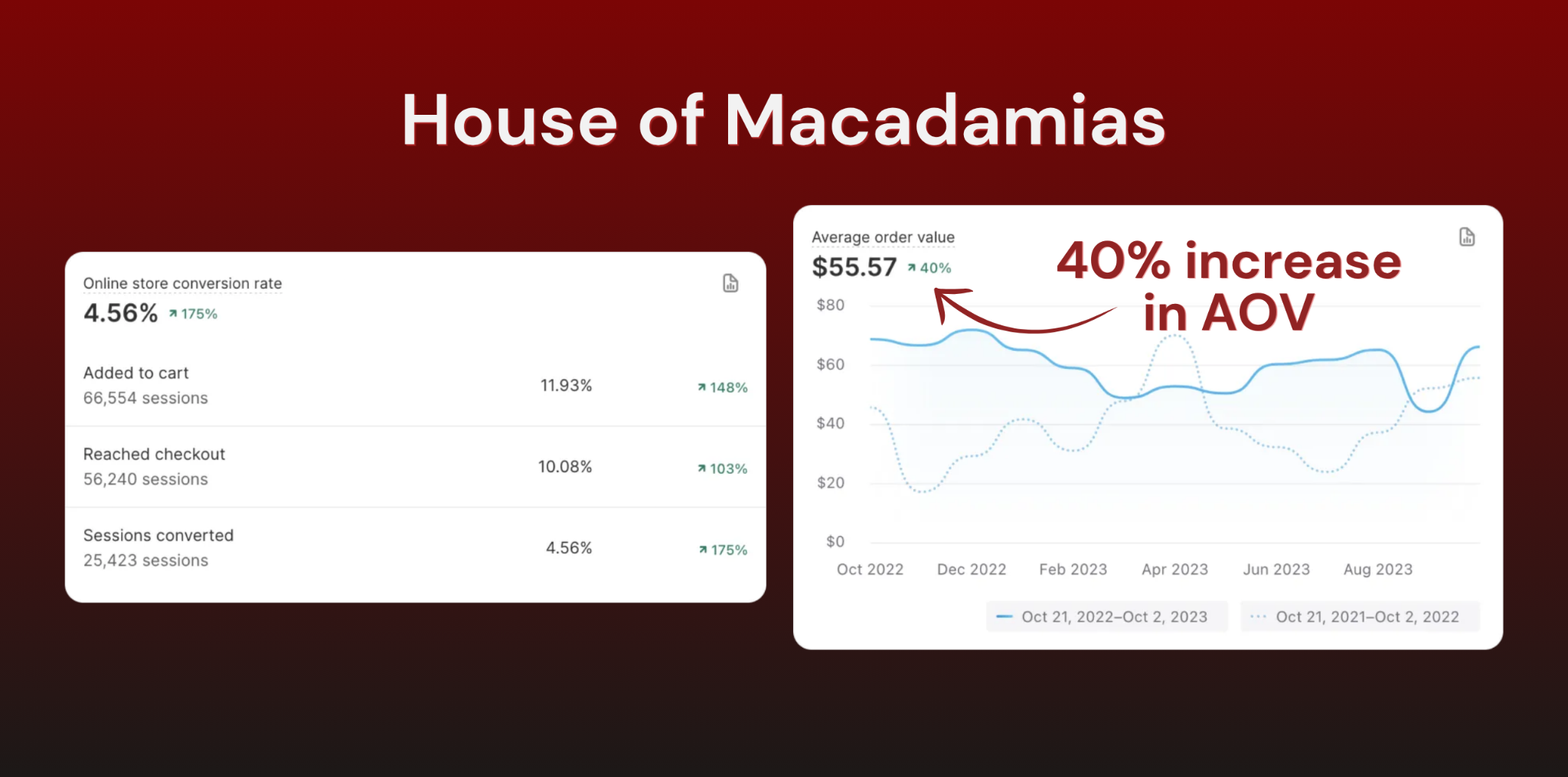
House of Macadamias: 40% AOV increase
House of Macadamias were dependent on an offshore developer for every single storefront change, with years of unstructured tweaks and no coherent funnel behind any of it.
Platter rebuilt the funnel with upsells and cross-sells embedded throughout, not latched on at the end.
Within the first year: a 175% increase in conversion rate year over year, and a 40% increase in AOV.
BoomBoom Naturals: 23% AOV increase
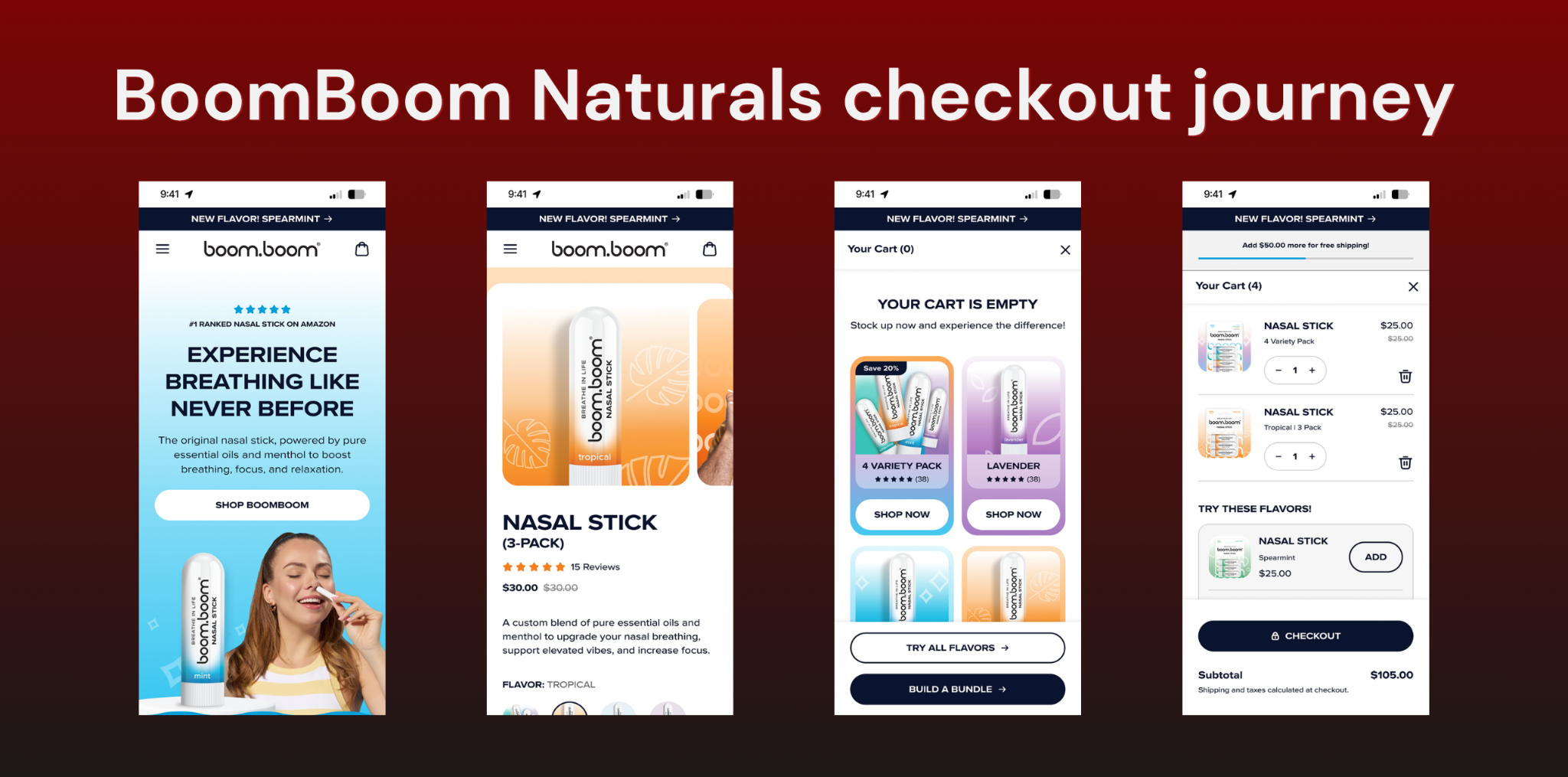
BoomBoom Naturals had a different problem: an outdated design and a broken sold-out product experience that quietly bled conversions.
Platter built them a custom Build-a-Bundle page - mix-and-match products with tiered discounts ("buy 3, save 20%") - powered by Shopify's native discount engine.
Result: a 27% increase in conversion rate and a 23% increase in AOV.
Neuro: 42x ROI in 6 months
Neuro saw the same principle play out at an even more granular level.
A handful of Platter+ checkout extensions - cross-sells, a tiered progress bar, alert banners - added $67k in revenue at a 42x return in 6 months.

In this blog, we’ve seen three different DTC brands use three different tactics, i.e., Bundling, embedded upsells, and checkout extensions - all deployed at the checkout funnel.
Your takeaway
If your returning customer revenue has plateaued, don’t worry about your flows, your segmentation or campaign cadence immediately.
Instead, focus on your checkout page where the customer has already said yes. Every flow and campaign in your retention stack is working to bring that customer back. The checkout determines how much they spend when they get there. If that layer doesn’t have cross-sells, bundling mechanics, or post-purchase offers, you are leaving money on the table that no email can recover.
Fix the funnel before you fix the follow-up.
The retention hierarchy exists for a reason. Acquisition quality, product fit, and the checkout experience all sit below the remarketing layer. Build the foundation correctly and the email strategy above it performs better. Try to shortcut to layer 5 while layers 2 and 4 are broken and you will spend years chasing an AOV number that never moves.
FAQs
Why doesn't improving email flows increase AOV?
Because AOV is determined at the point of purchase, not in the inbox. Email flows influence whether a customer comes back. They have almost no influence over how much that customer spends when they do. The checkout experience - specifically in-cart cross-sells, spend-threshold progress bars, and post-purchase offer pages - is what determines order value. A perfectly segmented Klaviyo account cannot compensate for a checkout that fails to capture buying intent at its peak.
What is the highest-intent moment in the eCommerce customer journey?
The second immediately after a customer clicks "Buy Now." At this point they have already committed psychologically and financially. Their attention is fully on the transaction and their openness to adding more is higher than at any other point in the journey. This is why post-purchase offer pages consistently outperform any email sent days later - the timing is structurally better, not just marginally better.
What Shopify checkout tactics increase AOV most effectively?
Based on Platter's client results across 200+ storefronts and over $1bn in GMV, the highest-performing tactics are:
- In-checkout cross-sells that recommend complementary products before order confirmation
- Tiered spend-progress bars that gamify reaching the next threshold
- Post-purchase offer pages shown immediately after transaction completion, and
- Bundle mechanics that reward buying more upfront.
These tactics work because they reduce friction and capture intent rather than trying to manufacture it later.
How does checkout optimisation fit alongside email and SMS retention?
It sits underneath retention in the hierarchy. Acquisition quality, product fit, and the checkout experience all determine the ceiling on what email and SMS can achieve. Fix the checkout and you multiply the return on every flow and campaign running above it. Leave it broken and retention marketing is trying to extract value from a funnel that was leaking before the customer ever entered your email list. The two are not alternatives. Checkout optimisation is the foundation that makes retention marketing more effective.
What results have Shopify brands seen from checkout optimisation?
Platter's case studies show a 40% AOV increase for House of Macadamias through embedded upsells and cross-sells throughout the funnel, a 23% AOV increase for BoomBoom Naturals through a custom Build-a-Bundle page with tiered discounts, and a 42x ROI in six months for Neuro through checkout extensions including cross-sells and a tiered progress bar. These results span different brand categories, different tactics, and different starting points - which suggests the lever itself is structurally reliable rather than dependent on a specific brand type.
Is checkout optimisation only relevant for large Shopify brands?
No. The tactics - in-checkout cross-sells, progress bars, post-purchase offer pages - are available to Shopify brands at most plan levels and do not require significant development resources to implement. Platter's work with Neuro shows a 42x ROI from a small number of checkout extensions. The upside scales with order volume, but the mechanics work regardless of brand size. The question is not whether a brand is large enough to benefit. It is whether the checkout is currently capturing the buying intent that already exists.
Related reads
- Why Your eCommerce Subscription Revenue Has Plateaued (And What To Do About It)

.svg)


1.png)
.png)