
50% of subscribers churn before their second order.
At Magnet Monster, we’ve seen brands ignore that number constantly, because they’re looking at subscription health by month instead of tracking it by order number. If you run a DTC subscription business, this is one of the most dangerous habits you can pick up.
A paused subscriber isn't churned similar to how a skipped order isn't. But if the revenue isn’t clocked, it doesn't matter what the reason is.
Every metric that matters in the DTC subscription business: take rate, churn, lifetime value, needs to be tracked by order number instead of by month. If you get that wrong, you'll end up pursuing the wrong retention strategy based on numbers that look healthier than your business actually is.
What is subscription retention?
Subscription retention is whether a customer places another order. Some brands tend to refer to it as a customer who is “subscribed” - we don’t prefer that definition.
At Magnet Monster, we’ve audited subscription brands whose dashboards combine the two. A customer who's paused, skipped or delayed their next order still shows up as an ‘active subscriber’, because they haven't formally cancelled.
But an active subscriber and a paying customer aren't the same thing.
Retention only means something when it's measured by order number: did this customer come back and buy again at each stage of their subscription, and not whether their status field still says "active."
Why does tracking subscription retention by month hide real churn?
Because a paused or skipped subscription doesn't get classed as churn, but the recurring revenue it was supposed to generate never gets clocked. So, obviously that is not retention. Instead, it is delayed churn, or deferred churn, dressed up as a healthy number.
That pause usually gets decided in one place: the billing reminder email, and whether it makes delaying easier than cancelling.
That’s why when you look at monthly recurring revenue on its own you could miss this completely. Your active subscriber count holds steady and your churn rate looks fine Meanwhile the actual revenue coming into the business isn't increasing, because the customers you're counting as retained aren't actually ordering.
This is exactly the blind spot that leads brands into the wrong retention strategy when they're trying to scale.
How do you build a subscription retention cohort by order number?
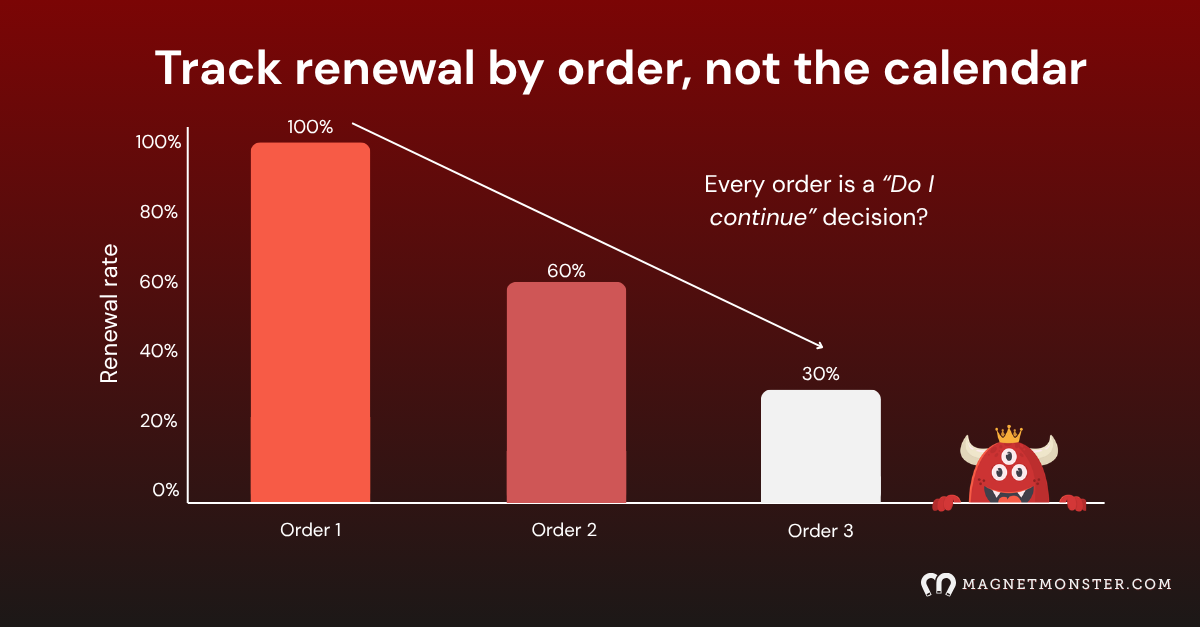
Break your cohorts down by order number, first order, second, third and beyond, instead of by calendar month, then plot the retention curve to see exactly where the drop-off happens.
This gives you a far more accurate read on how healthy your subscription programme actually is than any monthly view can.
It matters even more if you're not selling on a straightforward 30-day cycle.
- A weekly subscriber makes four renewal decisions a month, not one. A monthly view can only show one of them, so it hides the other three.
- Bi-weekly subscriptions have the same problem at a different scale.
- 60-day and 90-day subscriptions get the opposite distortion: a customer can look "churned" on a monthly view when they were never due to reorder that month in the first place.
Order-number cohorts strip all of that noise out. You see the real curve, not an artefact of how your billing cycle happens to line up with the calendar.
That curve is what should be informing your churn mitigation strategy and where the real lifetime value opportunity sits, and not a monthly snapshot that was never built to answer that question.
How to improve subscription retention
Once you can see the real drop-off point by order number, two decisions follow directly from it.
- When should you start cross-selling and upselling subscribers?
Generally not before order three or four.
The exact point depends on what you're selling and how the subscription is packaged upfront, but pushing cross-sells and upsells too early, before a customer has proven out their own retention curve, adds friction at exactly the moment you're trying to prove the core product works.
Wait until the cohort shows a customer has moved past your highest-risk order number. Then start layering in additional revenue. The 4-play upsell sequence we run once that risk window has passed is built around exactly this order-number logic, not a calendar trigger.
- Should you sell a higher AOV package upfront instead of smaller items?
If your churn is concentrated around order two, this is worth testing seriously.
50% of subscribers churning before their second order is a widely-seen benchmark in DTC subscription businesses, and if your own cohort data shows the same cliff, smaller incremental low-AOV items aren't giving the customer enough reason, or enough product, to make it to order three.
A higher LTV package with a longer upfront commitment can outperform a string of small, easy-to-cancel orders, precisely because it removes the decision point where most of your churn is actually happening.
Neither of these calls make sense without the order-number view first. You need to know where the cliff is before you decide how to build around it.
Read: How to Email Active Subscribers to Grow LTV for DTC Subscription Brands
Why do post-third-order subscribers deserve more marketing?
That 50% cliff at the second order isn't where it stops. By the third order, cumulative churn typically reaches around 70%. Flip that number round and it tells you that once a subscriber crosses that milestone, churn flattens hard.
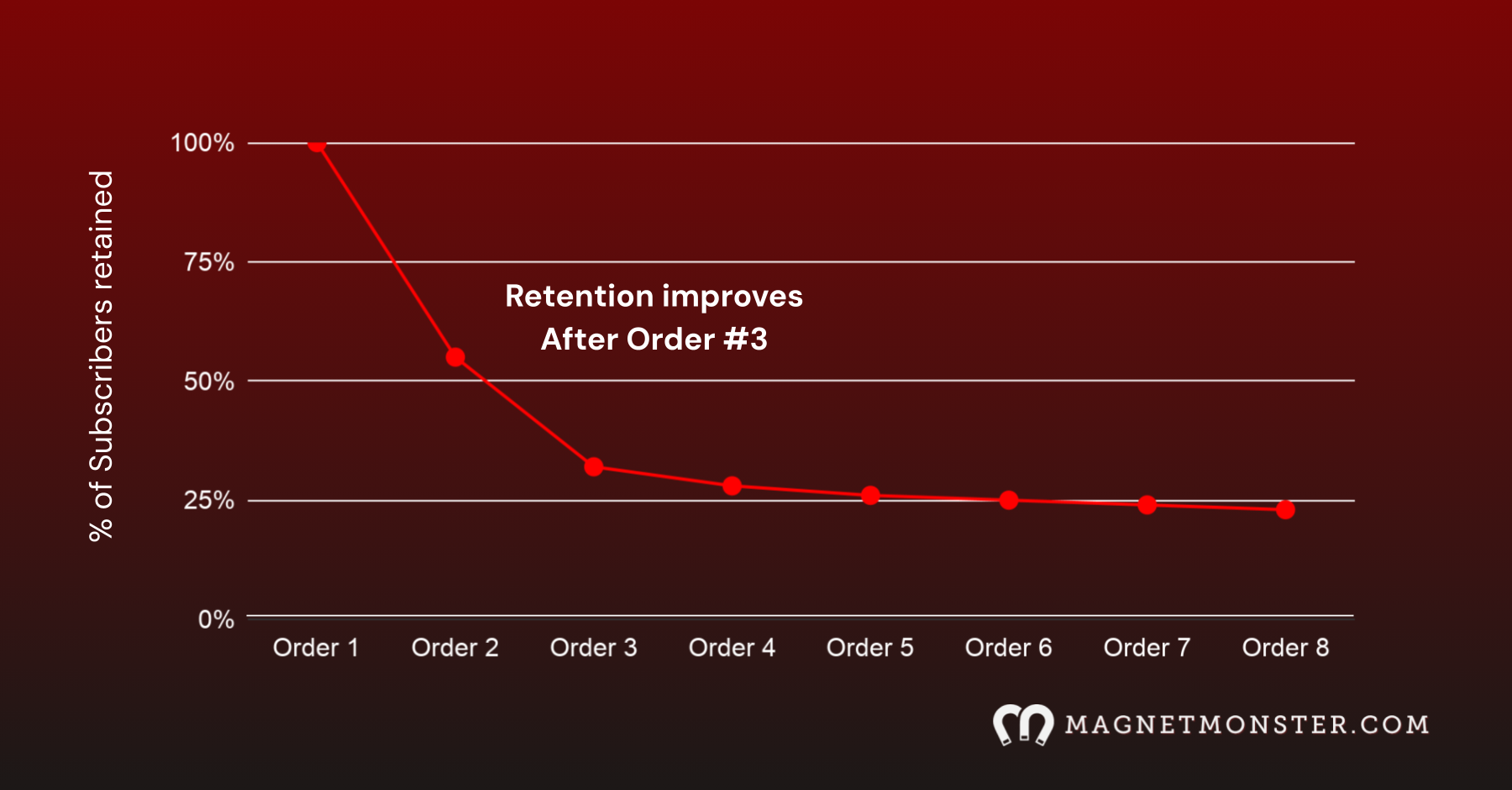
They're using the product, seeing results, and they've built a routine. That's exactly the point most brands go quiet.
Somewhere along the way, DTC convinced itself of a dangerous myth: don't email your active subscribers, or you'll cause them to churn.
That belief is costing subscription brands millions in recurring revenue every year.
Once retention stabilises past the third order, the priority should shift. Stop treating every active subscriber as a churn risk to be left alone, and start treating them as the biggest AOV and lifetime value lever in the business.
Here's what that's worth in practice:
Take a subscription brand with 10,000 active subscribers who've crossed the third-order milestone, on a $40 recurring AOV. That's $400,000 in MRR from this segment alone.
Nudge that blended AOV from $40 to $46 with a strategic cross-sell, one extra small SKU added to the recurring order, and that's a 15% lift.
- Month 1: $60,000 in additional revenue
- Over 6 months: $360,000
- Over 12 months: $720,000
And that's before the second-order effect. A subscriber with a higher AOV and more SKUs in their order is more entrenched in the brand, and harder to cancel.
But if you stay silent instead, for fear of causing churn, then you bid adieu to the better part of a million dollars a year for nothing.
If you're genuinely nervous that emailing active subscribers will cause them to churn, ask the harder question first: is the product good enough to retain them at all?
A subscription that only "works" when you stay silent and hope nobody notices the recurring charge isn't a retention strategy. It's a countdown.
Post-third-order subscribers are the most under-marketed-to cohort in DTC, and usually the biggest LTV lever sitting untouched in the business.
What is the formula for subscription retention rate?
Subscription retention rate is the number of subscribers retained at a given order number, divided by the number of subscribers who reached that same order number, calculated cohort by cohort and by order number rather than by calendar month, for the reasons above.
Track your subscription business by order number and you'll see problems, and opportunities, that a monthly view was never going to show you.
If you're not sure whether your churn is real or just a tracking artefact, that's exactly what our DTC subscription audits are built for. Get in touch and we'll walk through your cohorts with you.
Want more of this in your inbox? Subscribe to our newsletter and YouTube channel for weekly DTC retention strategies, extracted straight from the brands we work with. No fluff, just actionable plays.

.svg)


1.png)
.png)